V-Mail: WWII's Microfilm Letters That Beat Spies
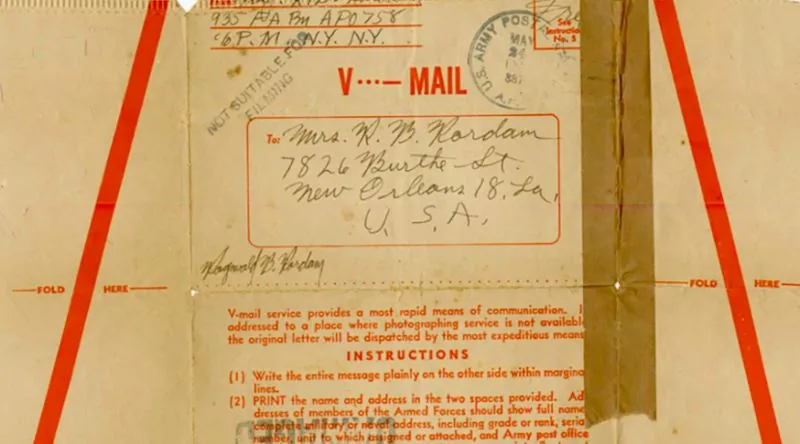
V-Mail was the U.S. military's microfilm mail system in World War II, launched in 1942 and run through 1945, that shrank soldiers' letters onto tiny film reels to save cargo space between the front lines and home. A single sack of film could carry what once filled dozens of mailbags, and the process had an unexpected side effect: it wiped out the invisible-ink messages spies tried to smuggle through the mail. For families waiting on word from Europe or the Pacific, that thin strip of film was often the only thread connecting them to someone they loved.
V-Mail was a World War II mail system that photographed letters onto microfilm, shipped the film overseas, and printed the letters again on arrival. It began in 1942 and saved enormous cargo space while also defeating spy messages written in invisible ink.
- V-Mail, short for Victory Mail, was introduced by the U.S. military in 1942 and remained in use until the war ended in 1945.
- Soldiers wrote on standardized single-sheet forms, and each letter was photographed onto 16mm microfilm before being shipped overseas.
- The microfilm was developed at receiving stations and printed back onto small photographic paper for delivery to the recipient.
- The system drastically reduced the weight and volume of mail cargo, freeing space for weapons, food, and medical supplies.
- Because letters were photographed, any hidden writing in invisible ink failed to reproduce, which helped block a known spying method.
The Mail Problem That Nearly Sank the War Effort
V-Mail was the United States military's answer to a simple, brutal arithmetic problem: too many letters, too few ships, and an ocean in the way. During World War II, mail was the only thread connecting soldiers and sailors stationed overseas to anyone at home, and that thread was stretched nearly to breaking.
Picture the volume. Letters poured in from every front, and every one of those pages had to physically cross an ocean. Delivery to the United States took anywhere from one to four weeks. Move the mail by cargo ship and the wait could stretch to a month. Fly it on a cargo plane and it might arrive in under two weeks, but that option was expensive, and the cargo hold was already spoken for.
That last point was the real squeeze. Planes crossing the Atlantic carried critical weapons and supplies, and letters were heavy and bulky, eating up space that ammunition and rations needed. The military postal service went looking for a way out and found one across the Atlantic, in a British process called the airgraph.
The idea behind it was almost absurdly clever. A letter would be written on a pre-printed form, censored, then photographed onto microfilm. The film traveled by plane instead of the paper. On arrival, the letter was printed back onto photographic paper and handed to its reader. The U.S. military postal service adopted the process under a new name: Victory Mail, or V-Mail.
Borrowing the British Airgraph
When the U.S. military postal service went looking for a way out of its paper problem, it did not invent one. It borrowed. The idea it borrowed was the British "airgraph," and in American hands it got a new name: Victory Mail, or V-Mail. That single rename marked the moment a British wartime experiment turned into an American institution, one that would run from June 1942 to November 1945.
The airgraph's exact origins are murky. Popular accounts tie it to Eastman Kodak Company working alongside Imperial Airways (the carrier we now know as British Airways) and Pan-American Airways, but those details do not hold up cleanly under scrutiny. What matters for the borrowing is simpler: the concept existed, it worked, and the U.S. military postal service saw a solution it could scale.
The mechanics were almost elegant in their economy. A soldier wrote on a pre-printed form. The form was censored. Then it was scanned onto microfilm, and the microfilm flew. At the destination, the letters were printed onto photographic paper and delivered. No original paper crossed the ocean. No bulky envelope took up cargo space. Just a strip of film, light enough to ride along with the weapons and supplies that actually needed the room.
That is the transatlantic borrowing in miniature. A British wartime invention, renamed and re-scaled, became the system that carried American letters across two oceans for three and a half years.
How V-Mail Actually Worked
Start with a single sheet of paper. That is the whole trick behind V-Mail, the system the United States military postal service ran from June 1942 to November 1945 to move letters between the front lines and home.
The sheet was standardized stationery that doubled as letter and envelope. A soldier wrote his message on it, folded it, and sent it on. That alone saved enormous room, even before a single frame of film was exposed. Picture the alternative: sacks of ordinary paper letters stacked in the belly of a cargo plane, weight and bulk competing with rifles and rations for the same space.
From there the sheet entered an assembly line. The letter was censored, then photographed down onto microfilm. The film, not the paper, went overseas by air. On arrival, each frame was printed back onto photographic paper and delivered to the doorstep. The print came out at roughly one-quarter the size of the original letter. If the reproduction was poor, the final product was simply unreadable.
The savings were real. One frequently repeated figure holds that 37 mail bags of paper letters could be condensed into a single bag of film, though those numbers are hard to verify and should be treated with caution. The scale of the operation is likewise uncertain: estimates of items processed range from hundreds of millions to over a billion.
One consequence was accidental. Because only photocopies of the letters traveled, invisible ink and microdots became useless, which quietly discouraged espionage.
There were costs to the reader, too. Only a limited number of words fit on a form, which made the format restrictive. And as the story goes, some stores even began selling special glasses to help people decipher the shrunken print, though that detail is not firmly documented.
The Astonishing Math of Microfilm
Picture a warehouse of mailbags stacked to the ceiling, then picture a single sack sitting alone on the floor. That is the promise V-Mail made to the U.S. military postal service, and the numbers behind it are almost hard to believe. One widely repeated account holds that 37 mail bags of paper letters could be condensed into one mail bag of film. Those exact figures are cited constantly but have never been independently verified, so treat them as the story's headline claim rather than a settled statistic.
Even so, the principle was real, and the payoff was enormous. Every pound of paper that never had to cross an ocean was a pound of cargo space freed up for weapons, ammunition, and supplies. Multiply that by thousands of sacks of mail, and the arithmetic starts to look less like a postal convenience and more like a logistics victory.
What the Scale Really Was
Here is where a popular version of the story goes wrong. You will sometimes read that the United States printed the letters at only 60 percent scale to trim waste further. That is not what happened. V-Mail prints were reduced to roughly one-quarter the size of the original letter, a far more aggressive shrink than 60 percent, and the reason the finished product could be genuinely hard to read.
That tiny print had consequences the planners could not fully control. If a reproduction came out too small or too faint, the final print was simply unreadable, and the message was lost somewhere between the censors and the mailbox. As the story goes, some stores even began selling special glasses to help readers decipher the reduced print, though that particular detail is unconfirmed.
Reported, not verified
The famous 37-bags-to-1-bag conversion comes straight from the original account. The figures are cited constantly, but no independent record confirms them exactly.
What is not in doubt is the direction of the savings. Microfilm let the military move a mountain of correspondence in a fraction of the space, and every cubic foot it saved went toward the war effort instead.
The Accidental Spy-Stopper
Here is the part nobody planned for. V-Mail was built to save cargo space, not to catch spies. Yet by the time the system was running, it had quietly closed a door that intelligence officers had worried about for years. Because only photocopies of letters traveled overseas, invisible ink and microdots became useless. The original sheets never left the country.
Think about how a wartime letter actually moved through V-Mail. A soldier wrote on a single standardized form, the kind that folded into its own envelope. Censors read it. Then a camera photographed it onto microfilm. That film flew across the ocean, and at the far end the letter was printed onto photographic paper and handed to whoever was waiting. The paper the soldier actually touched? It went into the shredder. It was destroyed after microfilming. Whatever secret someone might have pressed into that sheet, whether in invisible ink or in a microdot the size of a period, never reached its destination. Only the photograph did. And a photograph captures what the eye can see, nothing hidden underneath.
Contrast that with the old way. A physical letter crossing the Atlantic was a physical object, and a physical object can carry a message no censor can read. Invisible ink develops later, in a kitchen, far from the mail bag. A microdot rides along like a speck of dust. V-Mail broke that chain almost by accident, because the logistics fix and the security fix happened to be the same fix. Shrink the letter to film, and you also strip away everything the film cannot see.
It is worth sitting with how strange that is. The same decision that let a single mail bag replace dozens of heavy sacks of paper also turned every letter into a copy. A copy is a wonderful thing for moving mail fast. It is a terrible thing for smuggling a secret. The planners at the military postal service were chasing weight and volume, not counterintelligence. They got the spy-proofing for free.
So the next time you picture a wartime letter, picture the original going into the fire and a tiny strip of film flying instead. The message survived. The hiding place did not.
What Soldiers and Families Gave Up
For all its cleverness, V-Mail asked something of the people who used it. A sender could only fit so many words on that single standardized sheet, and that limit felt tight. You wanted to tell your mother about the mud, the cold, the friend who did not come back. You had a few cramped lines, and then you ran out of room.
The reading end was worse. Prints came back at one quarter the size of the original letter, and when the reproduction was too small, the final product was simply unreadable. Imagine a mother in Ohio holding a scrap of paper the size of a playing card, squinting at handwriting shrunk to a quarter of its real size, trying to find her son's voice in it. As the story goes, some stores even began selling special glasses to help readers make out the reduced print, though that detail is unconfirmed.
That is the trade the system made. Efficiency on one side, and on the other a family leaning toward a lamp with a magnifying glass, decoding the most important words they would ever receive.
The Numbers Behind V-Mail
V-Mail ran for just three and a half years, from June 1942 to November 1945, and then it was gone. In that window, the U.S. military postal service pushed an almost unbelievable volume of correspondence through a chain of censorship stations, microfilm cameras, cargo planes and photo labs. How much? Some accounts claim over 1 billion items passed through the system. That figure is worth handling carefully. Estimates swing widely, from hundreds of millions to more than a billion, so treat the billion as the top of a range rather than a hard count.
What the program proved is harder to argue with. Microfilm solved a genuine wartime logistics crisis, and it did so with a cheap sheet of film instead of a cargo hold full of paper. That idea, shrink the message so you can move the meaning, outlived the war itself.
How did V-Mail manage to move so much mail so fast?
V-Mail collapsed bulk into film. A stack of paper letters that would have filled dozens of mail bags could be reduced to a single bag of microfilm weighing a fraction as much, which freed critical cargo space on aircraft for weapons and supplies. The system ran from June 1942 to November 1945, and some accounts report that over a billion items moved through it, though estimates range from hundreds of millions upward.
What was the legacy of the V-Mail program?
V-Mail showed that microfilm could solve a wartime logistics crisis, shrinking thousands of pounds of paper into a single sack of film and opening cargo space for weapons and supplies. The service itself lasted only from June 1942 to November 1945, yet the principle it demonstrated, that information can travel lighter than the paper carrying it, echoed through later decades of record-keeping.
Frequently asked questions
What was V-Mail and why was it used during World War II?
V-Mail, short for Victory Mail, was a U.S. military postal system that turned letters into microfilm to save cargo space during World War II. Soldiers wrote on standardized forms that combined letter and envelope into a single sheet, which were then censored, photographed onto film, flown overseas, and printed on arrival.
How did the V-Mail system actually work from writing to delivery?
The process started with a soldier writing on a pre-made form, which was then censored and scanned onto microfilm. The film was flown across the ocean, and at the destination the letters were printed onto photographic paper and delivered. The U.S. military postal service adopted this process and named it Victory Mail, or V-Mail.
Why was V-Mail considered more efficient than regular mail for overseas soldiers?
Weight and space were the whole point. As the story goes, 37 mail bags of paper letters could supposedly be condensed into a single bag of film. That freed up critical cargo room on aircraft for weapons and supplies. The exact figures are frequently repeated but have not been independently verified.
Did V-Mail help prevent espionage, and if so, how?
Yes, and it happened almost by accident. Because only photocopies of letters were sent overseas and the originals were destroyed, any hidden messages written in invisible ink or embedded microdots became useless. The security benefit was an unintended side effect of the microfilming process, not a designed feature.
When did V-Mail start and end, and which military used it?
The U.S. military postal service operated V-Mail from June 1942 to November 1945. Despite that relatively short run of about three and a half years, the system processed hundreds of millions of items, with some estimates claiming over a billion, though that higher figure remains unconfirmed. Editorial note: Details that remain unconfirmed are presented as such and hedged accordingly.
Got a take on this? Add your voice to the conversation below →
No comments yet. Be the first.