Taksim Republic Monument: Why Soviet Generals Stand There
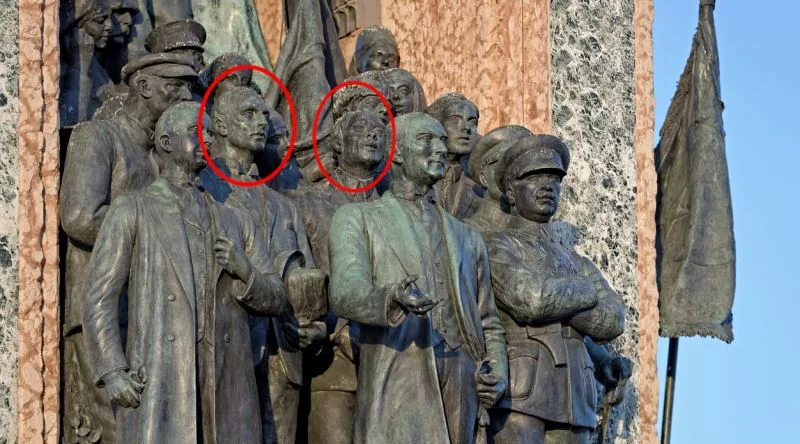
The Taksim Republic Monument in Istanbul includes statues of two Soviet generals, Mikhail Frunze and Kliment Voroshilov. The story goes that Atatürk personally ordered their inclusion to honor Soviet military aid during Turkey's War of Independence, though that personal order is repeated far more often than it is confirmed. The monument, unveiled in 1928, stands as a rare tribute to foreign allies on Turkish soil. It also casts a strange light on the man who was not there: Leon Trotsky, who would later live in exile in Turkey, far from the state that once counted Moscow as a friend.
Istanbul's Taksim Republic Monument, unveiled in 1928, features statues of Soviet generals Mikhail Frunze and Kliment Voroshilov. The figures are widely read as honoring Soviet support during the Turkish War of Independence, and the claim that Atatürk ordered them himself is reported but unconfirmed. The tribute reflects a brief era of Turkish-Soviet friendship, later complicated by figures like Leon Trotsky.
- The Taksim Republic Monument was unveiled in Istanbul in 1928.
- The claim that Atatürk personally ordered statues of Soviet generals Frunze and Voroshilov included in the monument is reported but not firmly confirmed.
- Soviet financial and military aid supported the Turkish nationalist movement during the War of Independence.
- According to the account, Mikhail Frunze visited Ankara in 1921 and saluted the Sakarya victory in the name of the Russian people, a detail that stays unconfirmed.
- Leon Trotsky lived in exile in Turkey after being pushed out by Stalin, a decade after the monument was unveiled.
Two Soviet Generals in the Heart of Taksim Square
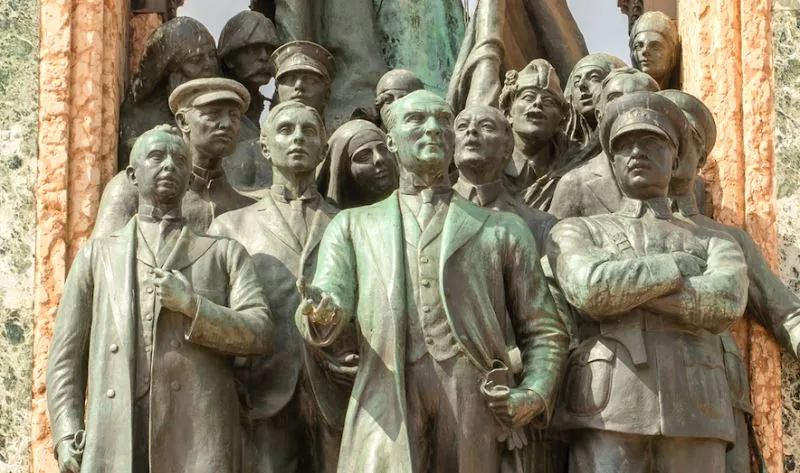
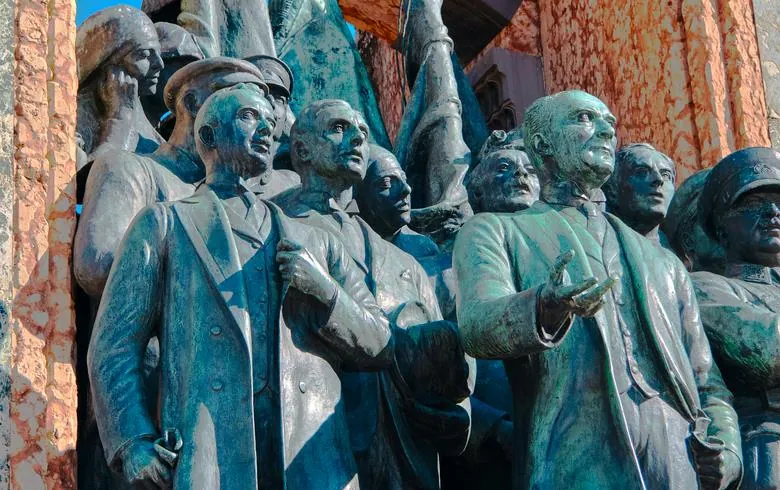
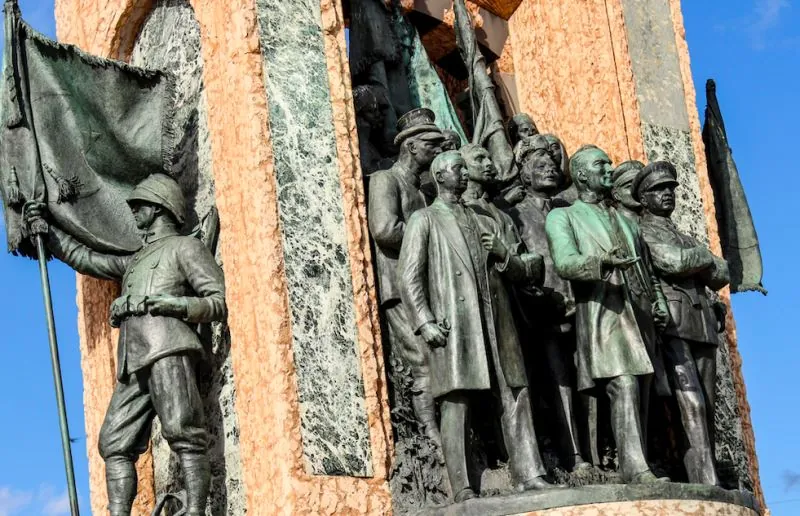
Stand in the middle of Taksim Square in Istanbul and look up at the Republic Monument. It has anchored that spot since August 8, 1928. Now look closely at the military group on the north face, the cluster of figures gathered around Mustafa Kemal Atatürk. Two of those bronze men are not Turkish at all. They are Soviet generals: Mikhail Vasilyevich Frunze and Kliment Vefremovich Voroshilov.
That is the small shock at the center of this story. A monument to the birth of the Turkish Republic carries, carved permanently into its stone, the faces of two commanders from Bolshevik Russia. Why would a young nation put foreign generals beside its founding father?
The answer reaches back to the Turkish War of Independence, fought between 1919 and 1923, when Ankara was scrambling for weapons, money and allies against the occupying powers. Frunze and Voroshilov are there as a gesture of thanks for Soviet aid delivered during those hard years. As the story goes, the figures were placed on Atatürk's personal instruction. That last detail is repeated often but has never been firmly confirmed, so hold it loosely: the gratitude is real, the personal order is the part that stays unproven.
The stories attached to each man are vivid. Reportedly, Frunze climbed the podium of the Turkish parliament in 1921 and congratulated the hall on the Sakarya victory in the name of the Russian people. Voroshilov, the account continues, traveled to Ankara in the war's darkest days with an open offer: guns if you need guns, money if you need money, just ask. Treat both scenes as the legend around the bronze rather than settled record.
What you can trust is what your eyes confirm. On a busy afternoon in Taksim, with the tram bells and the crowd noise, two Soviet generals keep standing at attention beside Atatürk. The Republic Monument Soviet generals pairing is not a trick of the light. It is right there in the metal, and it is where the stranger story begins.
The Men Who Came to Ankara: Frunze, Voroshilov, and the Soviet Hand
Walk up to the Taksim Republic Monument in Istanbul and look closely at the military group on its south face. Beside Mustafa Kemal you will find two men in Soviet uniform: Mikhail Frunze and Kliment Voroshilov. Their bronze presence on a monument inaugurated on August 8, 1928 is a documented fact. Why two Red Army commanders stand guard over the Turkish republic is where the story gets slippery.
The popular version hands them a starring role in Ankara's war years. As that account goes, Frunze climbed the parliament rostrum in 1921 and congratulated the Sakarya victory in the name of the Russian people. It also places Voroshilov in Ankara during the war's hardest days, promising plainly: if it is weapons, weapons; if it is money, money, ask and we will give. Both scenes are reported, not reliably established. Frunze did travel to Ankara in late 1921, but the specific speech celebrating Sakarya cannot be confirmed. A wartime Ankara visit by Voroshilov offering material support is likewise unverified.
The monument's Soviet figures do commemorate Soviet assistance to the national struggle. The claim that Atatürk personally ordered them placed there as a gesture of gratitude is unconfirmed.
One causal story attached to this chapter collapses on the calendar. The idea that Britain's failure to force the Dardanelles at Gallipoli kept the Soviets outside the revolution's sphere gets the order backwards: Gallipoli was fought in 1915, and the Russian Revolution came in 1917. The strait did not shape a revolution that had not yet happened.
And the Soviet face on the monument might have belonged to someone else. Lev Trotsky, then at the head of the Red Army, is said to have been far closer to Mustafa Kemal, with a friendship rooted in the war years and significant aid to his name. That personal bond and personal aid are contested; Soviet support was state policy, and no reliable evidence ties Trotsky's own hand to it.
What is certain is where Trotsky ended up. Stalin pushed him out of the party and sent him into internal exile at Alma-Ata. Pushed out of the Soviet Union, he found Western doors closed to him as a political refugee. Turkey took him in, and the conditions of that stay, along with the strange diplomacy around it, are a story of their own.
The Man Who Could Have Been on the Pedestal: Trotsky's Turkish Exile
Leon Trotsky never got a bronze figure on the Taksim Republic Monument. The popular version of the story says he almost did, that the head of the Red Army stood close to Mustafa Kemal and poured real help into the Turkish national struggle. Treat that with care. Soviet aid to Ankara was state policy, and no reliable evidence supports Trotsky's personal closeness to Kemal or any significant aid he gave on his own. The friendship is a good story, not a documented one.
What is documented is the fall. Stalin took the party, and Trotsky was expelled from it, then sent into internal exile to Alma-Ata. Keeping him alive inside Soviet borders was its own problem, so the plan shifted: push him abroad, wear him down, and finish it later. The West would not take him. Country after country declined to admit him as a political refugee, and for some governments the tidiest outcome was simply that he die on Soviet soil.
So the trail led to Turkey. As the story goes, Stalin asked Ankara to take him in, though a personal request from Stalin himself is not reliably confirmed. What Turkey did do was agree to admit Trotsky. The account then lists five spoken conditions set by Atatürk: that Turkey was no prison for Soviet Russia, that Trotsky would live freely under Turkish law, that he would get full political refugee treatment, that he could leave the moment another country granted him a visa, that he would not conduct political activity inside Turkey, and that Moscow would guarantee he would not be killed on Turkish soil. That specific list, guarantee and all, reads as embellished, so hold it loosely.
According to the account, Trotsky arrived in Istanbul and wrote to Atatürk saying he had not come by his own wish but had been pushed across the border, and that he would rather have gone to a country whose language he knew. The letter cannot be authenticated. The same goes for the detail that Atatürk sent the Istanbul governor to reassure him about his comfort and safety. Turkish authorities did make arrangements for his stay, but that particular gesture is not reliably confirmed.
He kept wanting to leave, restless in a country whose language he did not speak, and eventually he did. France took him, then expelled him; Norway took him, then expelled him too. He ended in Mexico, where in August 1940 a Stalin agent named Ramón Mercader killed him with an ice axe. Mercader drew the maximum 20 years under Mexican law at the time, then walked free. An ice axe tied to the murder has since turned up in a spy museum, though the exact chain of custody is unconfirmed. The pedestal in Taksim, meanwhile, kept only Frunze and Voroshilov.
From Istanbul to the Ice Axe: How Trotsky's Story Ended
Leon Trotsky did not get to stay on the Bosphorus. After his years in Istanbul, he was expelled from France, then from Norway, and finally found refuge in Mexico, where a Stalin agent killed him with an ice axe in August 1940. The assassin, Ramón Mercader, drew Mexico's maximum penalty at the time, twenty years, and later walked free.
Picture the man who had once stood at the head of the Red Army, now reading the news in a borrowed house, learning that yet another border had closed behind him. France pushed him out, then Norway followed, uneasy about hosting a man whose enemies never slept. Every door in Europe seemed to open only long enough to show him the way back out. Mexico was the last one that stayed open.
Then came the afternoon in Mexico, in August 1940. Mercader, sent by the Soviet security services, struck Trotsky with an ice axe. The wound was fatal. The killer's sentence was the stiffest the Mexican legal code of that era allowed: twenty years. He served it and was released.
Here the popular version drifts. Contrary to the story that Mercader vanished somewhere in Europe after his release, records indicate he traveled to the USSR and then Cuba, where he reportedly lived out his days. The ice axe itself has its own contested trail: as the story goes, it was hidden for years in a Mexican policeman's home before surfacing, and an ice axe tied to the murder has been displayed at the International Spy Museum. Whether that particular blade is the one that ended Trotsky's life, the chain of custody has never been firmly confirmed.
So the Taksim Republic Monument keeps its two Soviet generals, Frunze and Voroshilov, frozen in bronze since 1928, while the third man who might have joined them died half a world away, in a walled courtyard in Mexico, with an ice axe in the room.
Frequently asked questions
Why does the Taksim Republic Monument have statues of Soviet generals?
The military group on the Taksim Republic Monument, standing in Taksim Square since its inauguration on August 8, 1928, includes statues of the Soviet generals Mikhail Frunze and Kliment Voroshilov alongside Mustafa Kemal. The monument is commonly read as honoring Soviet assistance to the Turkish national struggle, though the exact reasoning behind the Soviet figures is reported and debated rather than firmly documented.
Who were Mikhail Frunze and Kliment Voroshilov?
Mikhail Vasilyevich Frunze and Kliment Vefremovich Voroshilov were generals of the Soviet revolution whose figures appear on the Taksim Republic Monument. According to the account, Frunze spoke before the Turkish parliament in 1921 to salute the Sakarya victory, and Voroshilov reportedly visited Ankara during the hardest days of the war to offer Soviet support. Both details are contested.
Did Atatürk personally order the Soviet generals' statues?
The claim that Atatürk personally ordered the Soviet generals' statues placed on the monument is reported but unconfirmed. What is documented is that the Taksim Republic Monument includes figures of Frunze and Voroshilov; the story that they were installed on Atatürk's direct instruction to symbolize gratitude for Soviet aid remains a contested part of the account.
What conditions did Atatürk set for Trotsky's stay?
The specific conditions Atatürk allegedly set for Leon Trotsky's stay in Turkey are reported and contested. As the story goes, five spoken terms were relayed to the Soviet ambassador, covering free residence under Turkish law, full political refugee status, freedom to leave with a visa, no political activity inside Turkey, and a Soviet guarantee not to harm him on Turkish soil. These terms cannot be reliably confirmed.
How was Trotsky killed and what happened to his assassin?
Leon Trotsky was killed in August 1940 in Mexico by the agent Ramón Mercader, who struck him with an ice axe. Mercader received the maximum 20-year sentence under Mexican law at the time and was later released. After his release he went to the Soviet Union and Cuba rather than vanishing in Europe, contrary to some popular versions. Editorial note: Details about the exact circumstances of Atatürk's order and the monument's design process that remain unconfirmed are presented here as such.
Got a take on this? Add your voice to the conversation below →
No comments yet. Be the first.