Sir Francis Drake: England's Daring 1577 Circumnavigation
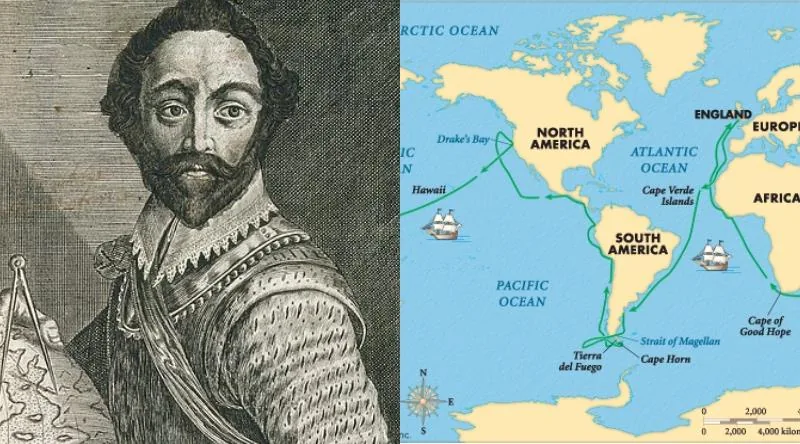
Sir Francis Drake was the English sea captain who, between 1577 and 1580, became the first Englishman to circumnavigate the globe, returning to Plymouth in September 1580 with a treasure-laden ship and a knighthood from Queen Elizabeth I. His story is one of audacious risk, brutal raids, and a burning rivalry with Spain that reshaped the map of the known world. You are about to meet a man who was either a glorious hero or a blood-soaked pirate, often both at once, and whose actions still echo in the arguments we have about empire and exploration today.
Sir Francis Drake was an English privateer and naval officer who led the second circumnavigation of the globe from 1577 to 1580. He raided Spanish settlements and treasure fleets, claimed land in California for England, and later helped defeat the Spanish Armada in 1588. He died of disease in 1596 off the coast of Panama.
- In December 1577, Drake departed Plymouth, England, with five ships and roughly 150 men on a secret mission sanctioned by Queen Elizabeth I.
- After passing through the treacherous Strait of Magellan in 1578, Drake's flagship, the Golden Hind, became the only vessel to survive the journey into the Pacific Ocean.
- In June 1579, Drake landed on the coast of what is now California, claiming the land for England and naming it New Albion.
- Drake completed his global voyage on September 26, 1580, when the Golden Hind returned to Plymouth laden with captured Spanish silver and gold.
- In 1588, Drake served as a vice admiral in the English fleet that defeated the Spanish Armada, cementing his legacy as a national hero.
The Boy from Devon Who Learned the Sea Early
Francis Drake came into the world in 1540 in Devon, a rugged county in southwest England where the salt air and crashing waves shaped the men who lived along its coast. He was not born into privilege or nobility. His family had little, and the sea was one of the few doors open to a boy with ambition and nothing else.
At just 13 years old, Drake climbed aboard a trading vessel headed for Guinea, the stretch of West Africa that was already becoming infamous for a brutal commerce. These were the years when European ships collected enslaved Black people from African shores and sold them to plantation owners in the Americas. Young Drake did not just witness this trade. He took part in it, sailing on multiple voyages while still a teenager, learning the routes, the winds, and the ruthless economics that ruled the Atlantic.
Back in England, the crown was watching the Spanish grow fat on New World gold and feeling the sting of being locked out. So Queen Elizabeth's government handed out what they called corsair licenses. These were official permissions for private ship captains to raid Spanish vessels and keep a share of whatever they seized. The English treasury took its cut, and the captains took the glory. Drake was one of the men who stepped into that role with remarkable skill, and he quickly became a name the Spanish learned to dread.
Drake's hatred of Spain ran deep, and it shaped everything that came after. The exact incident that sparked it is a matter of historical debate, but what is clear is that by the time he was a young man, he had already experienced the dangers of the sea and the ruthlessness of the Spanish Empire firsthand.
The Secret Mission: Circumnavigating the Globe
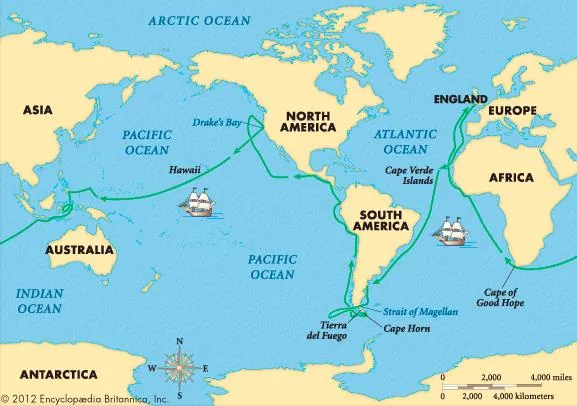
Queen Elizabeth I secretly commissioned the voyage in 1577, and Sir Francis Drake set sail with five ships and roughly 150 men. The official story was exploration, but the real objective was far bolder: pass through the Strait of Magellan and raid Spanish settlements along the Pacific coast of the Americas.
The secrecy made sense. Spain and England weren't at open war yet, but tensions were simmering, and the Spanish considered the Pacific their private lake. Drake's fleet slipped out of Plymouth harbor in December 1577, and for months the crew had no idea where they were truly headed. Only Drake himself knew the full plan.
They made it through the treacherous Strait of Magellan, the narrow passage at the tip of South America that had claimed many ships before them. Once they emerged into the Pacific, the raids began. Spanish ports and treasure ships along the coasts of Chile and Peru had no reason to expect an English ship, and Drake exploited that surprise again and again. Gold, silver, and precious stones piled up in the holds.
Somewhere along the coast of modern California, Drake made landfall and claimed the territory for England, naming it New Albion. As the story goes, he posted a brass plate to mark the claim, though historians have debated its authenticity for generations. What's certain is that this was a claim of sovereignty, not a settlement. No colony was established, and no English families remained behind. The first permanent English colony in North America would not come until Jamestown in 1607.
The voyage pushed on across the Pacific, through the spice islands of Indonesia, around the Cape of Good Hope at Africa's southern tip, and finally back toward England. Storms battered the ships, and what remained of the fleet grew smaller. When Drake finally dropped anchor in Plymouth on September 26, 1580, only one ship remained: the Golden Hind. Of the original 150 men who had departed three years earlier, just 30 came home.
That homecoming made history. Drake had become the first Englishman to circumnavigate the globe, a feat that put him in the company of Ferdinand Magellan's earlier voyage. But where Magellan had died halfway through, Drake returned to tell the tale, and to hand Queen Elizabeth a share of the treasure that made the entire venture wildly profitable. Investors who had put up one pound received 47 pounds back, a return that made Drake a hero in England and a name the Spanish would curse for generations.
Knighthood, Cadiz, and the Armada
Queen Elizabeth I knighted Francis Drake in 1581, tapping his shoulders with a sword aboard his own ship, the Golden Hind, which had carried him around the world. It was a stunning reversal of fortune for a man who had once been dismissed as a common pirate.
That same year, Drake took on a very different kind of duty. He became the Mayor of Plymouth in 1581, the bustling port city in Devon where he had grown up. Between plundering Spanish treasure and navigating royal politics, he now had to deal with local disputes, harbor fees, and civic matters. It was an odd fit for someone who had spent years on the open ocean, but Plymouth was loyal to him, and he served his term.
The knighthood and the mayoralty were only the beginning of his ascent. Tensions between England and Spain had been simmering for years, and by 1585 the two nations were officially at war. Drake, now an admiral in the English fleet, wasted no time taking the fight to the enemy.
In 1587, he led a daring raid on the Spanish port of Cadiz. His ships slipped into the harbor and destroyed dozens of Spanish vessels, an attack that became known as "singeing the King of Spain's beard." The Spanish called him "El Draque," meaning The Dragon, a name that reportedly struck fear into their sailors. According to the original account, the Spanish were so rattled that they began inventing wild legends about him, claiming he had supernatural powers and could control the winds themselves.
Then came the showdown everyone had been waiting for. In 1588, King Philip II of Spain sent his massive fleet, known as the Invincible Armada, to invade England. The Spanish believed their ships were unstoppable, but the English had other ideas. Drake was one of several commanders who helped defeat the Armada, a collective effort that involved smaller, faster ships, clever tactics, and a bit of luck with the weather. The Spanish fleet was scattered, battered, and ultimately driven off.
By the time the smoke cleared, Drake had cemented his reputation as one of the most feared and celebrated seamen in English history. The Spanish saw him as a nightmare in human form, a relentless predator who seemed impossible to catch. The English, on the other hand, saw him as a hero who had protected their shores and filled their coffers with stolen gold.
But even as Drake basked in glory, darker currents ran beneath the surface. His hatred of Spain ran deep, fueled by an old wound from his younger days. He never forgave the Spanish for that betrayal, and it shaped everything that came after.
For now, though, Drake stood at the peak of his power. Knighted by the queen, adored by his countrymen, and feared by his enemies, he had become a living legend. The Dragon of the Spanish seas had earned his name.
Death and Legacy: Hero or Pirate?
Sir Francis Drake died of dysentery on January 28, 1596, off the coast of Portobelo, Panama, and was buried at sea in a lead coffin. The man who had terrorized Spanish fleets for decades never made it back to England. His body rests somewhere beneath the waves, and no one has ever recovered it.
The end came during a campaign in the Caribbean, a region he knew intimately from years of raiding Spanish treasure ships. Dysentery, that quiet killer of sailors, took him down faster than any Spanish cannon ever could. His crew placed his body in a lead coffin before committing it to the deep. The exact spot remains unknown, which has only added to the legend.
How you remember Sir Francis Drake depends entirely on which side of the English Channel your ancestors lived. In England, he was a knight, a hero, and the man who helped break Spanish naval dominance. Queen Elizabeth I had knighted him in 1581 aboard his ship, the Golden Hind, after his circumnavigation. He went on to serve as Mayor of Plymouth in 1581, a civic role that seems almost quaint for someone who had spent years burning Spanish ports.
To the Spanish, he was something else entirely. They called him "El Draque," the Dragon, a name that stuck long after his death. Spanish mothers supposedly used his name to frighten disobedient children. The Spanish king Philip II reportedly placed a bounty on his head, though no reliable contemporary record confirms that specific figure. The hatred was real, regardless of the exact price tag.
The financial legacy is easier to measure. Investors who backed his circumnavigation voyage received about a 47-fold return on their money. One pound invested came back as 47 pounds. That kind of return explains why English merchants kept funding his expeditions even when the Spanish complained loudly about piracy. The Golden Hind itself carried so much captured treasure that it reportedly sagged low in the water when it finally returned to England in 1580.
Today, a full-scale replica of the Golden Hind sits moored in London, where it serves as a museum. Contrary to what some travel guides claim, it is not located near the Old Thames Inn pub. Visitors can walk the decks and imagine what it felt like to sail around the world in a wooden ship with only 30 of your original 150 crewmates still alive.
Drake's legacy remains complicated. He was a slave trader in his youth, participating in voyages that transported enslaved Africans to the Americas. He caused countless deaths through his raids and campaigns. Yet he also helped establish England as a naval power and became the first Englishman to circumnavigate the globe. The same man who knelt before Queen Elizabeth to receive his knighthood had ordered executions and burned cities.
Perhaps that is why his story still fascinates. Sir Francis Drake was not simply a hero or a pirate. He was both, and neither, and something far more human than either label suggests. His lead coffin still lies somewhere off Panama, holding the remains of a man whose name meant salvation to some and terror to others.

Frequently asked questions
Who was Sir Francis Drake?
Sir Francis Drake was an English sea captain, explorer, and privateer born in 1540 in Devon, England. He became the first Englishman to sail completely around the globe, completing the journey in 1580. Drake was a licensed privateer who raided Spanish ships and settlements, making him a celebrated hero in England and a feared pirate in Spain.
Did Francis Drake really circumnavigate the globe?
Yes, history confirms Drake's circumnavigation. He set sail from England in 1577 with five ships and roughly 150 men, and he returned on September 26, 1580, with only about 30 of his original crew still alive. That three-year voyage made him the first English captain to circle the entire planet, a feat celebrated across England.
Was Francis Drake a pirate or a hero?
Drake was both, depending on who you ask. Queen Elizabeth I of England granted him a privateering license, which made his attacks on Spanish ships legal under English law. The English celebrated him as a knighted national hero, while the Spanish considered him a pirate and a terror of the seas.
How did Sir Francis Drake die?
Drake died of dysentery on January 28, 1596, near Portobelo, Panama, during a military campaign. His body was placed in a lead coffin and buried at sea. To this day, divers and historians have never recovered his remains from the ocean floor. Editorial note: This account is based on the known historical record, and any facts which remain unconfirmed, such as the exact location of his 1579 California landing, are presented as such with appropriate hedging.
Got a take on this? Add your voice to the conversation below →
No comments yet. Be the first.