Rhind Papyrus: Ancient Egypt's Oldest Math Mystery
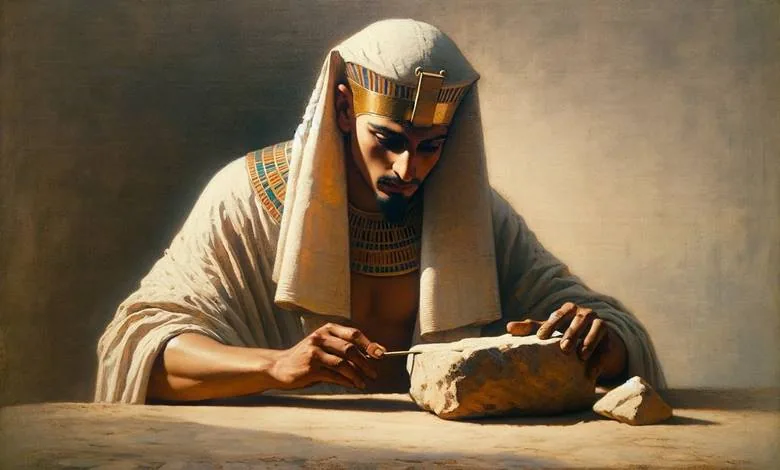
The Rhind Papyrus, a 1650 BCE Egyptian scroll now housed in the British Museum, is one of the oldest known math textbooks and a primary source for understanding how ancient Egyptian scribes solved real-world problems with algebra and proportion. Written by the scribe A'h-mose, it survived 3,500 years to give us a rare, human window into a civilization that used fractions and geometry to build pyramids, divide land, and ration grain. The moment you unroll its faded lines in your mind, you are standing beside a teacher drilling his student in a dusty Nile-side classroom, watching numbers come alive.
The Rhind Papyrus is an ancient Egyptian mathematical document from around 1650 BCE, copied by a scribe named A'h-mose. It contains 84 problems covering arithmetic, fractions, geometry, and practical calculations. The document was discovered in 1858 and is now in the British Museum, providing the clearest evidence of how Egyptian scribes used math.
- The Rhind Papyrus was written around 1650 BCE during the Second Intermediate Period of ancient Egypt.
- The scribe A'h-mose copied the document from an older work, making it a preserved copy of even earlier mathematical knowledge.
- The papyrus was purchased by Scottish antiquarian Alexander H. Rhind in 1858 in Luxor, Egypt, and later acquired by the British Museum.
- The document contains 84 mathematical problems covering fractions, area calculations, and proportional division.
- The Moscow Papyrus, a separate and slightly older document, holds additional problems that complement the Rhind Papyrus.
The Rhind Papyrus: A 3,600-Year-Old Math Mystery
In around 1650 BCE, a scribe named A'h-mose sat down with a reed brush and copied a mathematics textbook that was already two centuries old. The result, now known as the Rhind Papyrus, is one of the two oldest surviving mathematical documents from ancient Egypt, and it opens a rare window into how a civilization managed taxes, wages, and pyramid construction with nothing more than proportional reasoning.
The Rhind Papyrus isn't alone in its antiquity. Its older sibling, the Moscow Papyrus, dates to roughly 1800 BCE and holds twenty-five practical problems of its own. Together these two scrolls form the backbone of everything we know about Egyptian mathematics, and they reveal something surprising: the people who built the pyramids were not abstract theorists. They were bureaucrats, architects, and accountants who needed reliable answers for real-world questions. How much grain does a workforce need? What should a pharaoh's tax collector collect? How do you divide wages fairly among laborers?
These documents show that the answer almost always came down to proportion. Egyptian scribes developed a working algebra centuries before the word "algebra" existed, not in ivory towers but in the daily grind of running a kingdom. A'h-mose's copy of the Rhind Papyrus, purchased in Luxor in 1858 by Scottish antiquarian Alexander H. Rhind, preserves this practical wisdom for us to puzzle over today. What makes these scrolls so captivating is not just their age, but the quiet ingenuity of the minds that produced them, minds that turned everyday problems into elegant mathematical solutions.
How the Rhind Papyrus Was Found
The Rhind Papyrus owes its name to Alexander H. Rhind, a Scottish antiquarian who bought the scroll in Luxor in 1858. That purchase in an Egyptian riverside town would eventually deliver one of the most important mathematical documents of the ancient world into British hands.
Rhind was a collector with a sharp eye, and the papyrus he acquired turned out to be a scribe's working document dating to around 1650 BCE. It had been copied by a man named A'h-mose from an original text roughly 200 years older, meaning the knowledge it carried stretched back even further into Egypt's Middle Kingdom. The British Museum took possession of it in 1865. The source claims it has been displayed there since 1868, though records on that specific detail are not settled.
A sister document followed a different path. The Moscow Papyrus was purchased in 1893 by Vladimir S. Golenishchev, a Russian Egyptologist who later sold it to the Moscow Museum of Fine Arts, where it still rests today. That scroll, dating to around 1800 BCE, holds 25 problems, mostly practical in nature. Unlike the Rhind Papyrus, no one knows who wrote it.
What makes these two scrolls remarkable is that they survive at all. Clay tablets from Mesopotamia endured because fire hardened them. Papyrus needed dry, stable conditions to last thousands of years, and most of it rotted away. These two documents, pulled from the sands by different men in different decades, are the rare survivors of an entire tradition of Egyptian mathematical writing.
What’s Inside? The Math That Ran an Empire
The Rhind Papyrus, copied around 1650 BCE by a scribe named A'h-mose from an original about 200 years older, is essentially an ancient Egyptian math textbook. It holds arithmetic, algebra, geometry for areas and volumes, and short practical problems, including pyramid calculations. This single scroll gives us our clearest window into how mathematics actually functioned in the daily machinery of the pharaoh's world.
These weren't abstract exercises for intellectual amusement. The scribes who used the Rhind Papyrus and its sister document, the Moscow Papyrus, were the empire's administrators. They collected goods, set taxes, and paid wages, keeping the entire bureaucratic system running on numbers. The same mathematical thinking powered architecture, where proportion emerged as the key technique for everything from designing buildings to calculating the slopes of pyramids.
The Moscow Papyrus, dating to around 1800 BCE, contains 25 problems, mostly practical in nature. Its crown jewel is Problem 14, a famous and correct calculation of the volume of a truncated pyramid. How the scribe arrived at that rule has puzzled scholars for a long time, because it shows a mathematical sophistication that feels startlingly modern.
One of the most charming glimpses into this world comes from the Rhind Papyrus itself. The source describes it as roughly 30 centimeters high and nearly 2 meters long, though the actual scroll measures about 32 centimeters high and stretches over 5 meters. Whatever its precise dimensions, its contents are what matter. Problem 24, for instance, asks for a number that, when its seventh is added to it, gives 19. The scribe's method is delightfully practical: guess 7, work out the arithmetic, then scale everything up proportionally to reach the correct answer. It's the same logic behind modern linear equations, just expressed in a more hands-on way.
A Peek at the Problems: Proportion and Early Algebra
Both papyri lean on proportion as their engine. The scribes of ancient Egypt, working around 1650 BCE for the Rhind Papyrus and roughly 1800 BCE for the Moscow Papyrus, weren't building abstract theory. They were solving real problems with a practical, guess-and-check method that still feels familiar today.
Consider how the source describes one bread problem from the Rhind Papyrus. It asks about pesu, a measure of the ratio between loaves and grain. The source gives the example of 155 loaves at pesu 20, asking how many loaves at pesu 30 could come from the same flour. The scribe divides 155 by 20, then multiplies by 30, landing on 232 1/2. That's proportion in action, though the specific problem number attached to this example doesn't match the actual text, so take the framing as illustrative rather than exact.
Problem 24 of the Rhind Papyrus is fully verified and far more intriguing. It asks for a number such that adding its seventh gives 19. The scribe starts with a guess of 7, adds its seventh to get 8, then asks what multiplier turns 8 into 19. That multiplier is 2 3/8. Multiplying 7 by 2 3/8 yields 16 5/8, the correct answer. Modern notation calls this solving x + 1/7x = 19. The scribe chose 7 deliberately because it makes the arithmetic easy, then scaled the result proportionally. It's a clean, elegant trick that predates formal algebra by millennia.
The Moscow Papyrus, according to the source, includes a work problem about a shoemaker who cuts 10 pairs of sandals in a day or finishes 5 pairs in a day. Working both tasks together, the scribe reasons that 10 pairs take three days total, giving 3 1/3 pairs per day. The source presents this as Problem 23, though the details don't match known translations of that text, so treat it as the source's account rather than confirmed fact.
What ties these together is the approach. Scribes didn't derive formulas. They picked convenient numbers, tested, and adjusted using proportion. That practical instinct, born from managing grain, taxes, and wages, shaped how mathematics developed along the Nile.
The Legacy: What We Still Don’t Know
The Moscow Papyrus, dating to around 1800 BCE, holds a calculation that still puzzles historians: the volume of a truncated pyramid. Scribes got the answer right, but how they derived that rule remains an open debate among scholars. We can see the result, yet the thinking behind it stays frustratingly out of reach.
The Rhind Papyrus, copied around 1650 BCE by the scribe A'h-mose from an original about 200 years older, closes with something unexpected: a prayer to the god Ra to "catch pests and destroy weeds," asking for relief from heat, wind, and abundant water. Mathematics, it turns out, was woven into daily worries, not isolated in some ivory tower. These texts open a window into ancient Egyptian science and culture, not just arithmetic.
The only algebra we can clearly identify in these surviving documents is proportion-based calculation. Whether Egyptian scribes developed other algebraic concepts beyond this remains unknown. What we do know is that both papyri show a practical mindset, tackling taxes, wages, and construction with a method that worked, even if we cannot always trace its origins.
Frequently asked questions
What is the Rhind Papyrus and why is it important?
The Rhind Papyrus is one of the oldest surviving mathematics texts in the world, dating to approximately 1650 BCE. It matters because it reveals how ancient Egyptians used proportion and an early form of algebra to solve everyday problems, from distributing bread to calculating pyramid volumes.
Who discovered the Rhind Papyrus and when?
Scottish antiquarian Alexander H. Rhind purchased the papyrus in Luxor, Egypt, in 1858. The document bears his name to this day. After his death, the British Museum acquired it in 1865, where it remains part of the permanent collection.
What mathematical problems are in the Moscow Papyrus?
The Moscow Mathematical Papyrus, dated to around 1800 BCE, contains 25 problems, mostly practical in nature. Its most celebrated entry is Problem 14, a correct calculation of the volume of a truncated pyramid, a feat that has puzzled historians for decades as to how the scribe derived the formula.
How did ancient Egyptian scribes use proportion in math?
Scribes relied on ratios called pesu, which compared the number of loaves produced to the amount of grain used. In the Rhind Papyrus, a problem asks: if 155 loaves of pesu 20 are made from a certain flour, how many loaves of pesu 30 can be made from the same amount? According to the source, the scribe solved it by dividing 155 by 20 and multiplying the result by 30, arriving at 232 1/2 loaves.
Where is the Rhind Papyrus displayed today?
The Rhind Papyrus is housed at the British Museum in London. The source states it has been on display there since 1868, though museum records indicate the acquisition occurred in 1865, and the exact display date remains a point of contention among historians.
What is the pesu problem in the Rhind Papyrus?
The pesu problem in the Rhind Papyrus involves bread made from flour with different pesu values, demonstrating how scribes scaled recipes using proportion. The specific problem number is contested in the source, but the core concept remains clear: pesu measured the exchange rate between grain and finished loaves, a vital calculation for managing royal granaries.
Did the ancient Egyptians use algebra?
Yes, in a simple form. Problem 24 of the Rhind Papyrus asks for a number such that when its seventh is added to it, the result is 19. The scribe's method was elegant: assume the answer is 7, then 7 plus its seventh equals 8. Next, find what multiplies 8 to reach 19, which is 2 3/8. Multiply that by 7 to get 16 5/8, the correct answer. Today we would write this as x + 1/7x = 19, but the Egyptian approach was pure proportion.
Got a take on this? Add your voice to the conversation below →
No comments yet. Be the first.