Matthäus Hetzenauer: WWII's Deadliest Sniper with 345 Kills
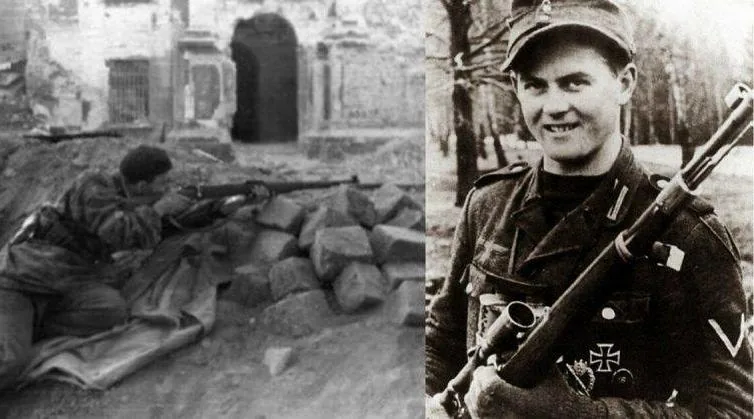
Matthäus Hetzenauer, an Austrian sniper in the German Wehrmacht's 3rd Mountain Division, was credited with 345 confirmed kills on the Eastern Front during World War II, earning the Knight's Cross in 1945 before being captured by Soviet forces. His story is one of quiet precision amid the brutal chaos of mountain warfare, where a single well-placed shot could decide the fate of an entire patrol. Hetzenauer's remarkable tally, achieved with standard-issue rifles and a sharp eye for terrain, made him a legend among his comrades and a feared presence to his enemies.
Matthäus Hetzenauer was an Austrian sniper in the 3rd Mountain Division who recorded 345 confirmed kills on the Eastern Front in World War II. He received the Knight's Cross in April 1945, was captured by Soviet forces in May, and spent nearly five years in a Soviet POW camp before his release in 1950.
- Hetzenauer served with the 3rd Mountain Division on the Eastern Front, primarily in the Carpathian Mountains and Hungary, from 1943 to 1945.
- He used a Karabiner 98k with a 6x scope and later a Gewehr 43 with a ZF4 scope, achieving his 345 confirmed kills with these standard-issue weapons.
- Hetzenauer received the Knight's Cross of the Iron Cross on April 17, 1945, one of the highest awards for bravery in the German military.
- He was captured by Soviet forces in May 1945 and held in a POW camp until his release in 1950.
- After the war, Hetzenauer returned to his native Austria, where he lived quietly until his death in 2004.
The Austrian Sniper Who Left His Mark on the Eastern Front
Matthäus Hetzenauer, an Austrian sniper serving in the 3rd Mountain Division during World War II, recorded 345 confirmed kills of enemy soldiers on the Eastern Front. That staggering number places him among the most lethal snipers of the entire conflict, a figure that still commands attention decades later.
Hetzenauer was born in the Tyrol region of Austria, a mountainous upbringing that suited his eventual assignment perfectly. The 3rd Mountain Division, known as the Edelweiß Division for its distinctive insignia, operated in brutal terrain where marksmanship and patience meant survival. Hetzenauer's rifle of choice was a Karabiner 98k fitted with a 6x telescopic sight, a weapon that demanded steady hands and nerves of iron. He also carried a Gewehr 43 equipped with a ZF4 4x scope, giving him flexibility depending on the engagement.
The Eastern Front was his theater, and it was unforgiving. Hetzenauer fought against Soviet forces across the Carpathian Mountains, through Hungary, and into Slovakia during 1944 and 1945. These were not stationary battles; they were fluid, desperate campaigns where snipers operated in small teams, often behind enemy lines, waiting hours for a single clean shot.
His service record tells a story of accumulating danger. On 6 November 1944, artillery fire sent shrapnel into his head, a wound serious enough to pull him from the line. Three days later, on 9 November, he received the Wound Badge in Black, a grim acknowledgment of how close he had come.
The recognition that followed was extraordinary. On 17 April 1945, Hetzenauer was awarded the Knight's Cross of the Iron Cross, one of Nazi Germany's highest military honors. The recommendation came from Generalleutnant Paul Klatt, his division commander, who cited a specific act of extraordinary courage: Hetzenauer had advanced under heavy artillery fire and direct enemy assault toward two enemy companies, eliminating numerous Soviet snipers along the way without regard for his own safety.
The war ended weeks later, and Hetzenauer's fate took a sharp turn. In May 1945, Soviet troops captured him. He would spend the next five years in a Soviet prison camp, released in 1950 to return to Austria.
Hetzenauer lived quietly for decades after his release. He passed away on 3 October 2004 in Brixen im Thale, Austria, leaving behind a wartime legacy that continues to fascinate military historians and marksmanship enthusiasts alike.
The Weapons and the Terrain: How He Fought
Matthäus Hetzenauer carried two rifles into battle, and both were built for precision. His primary tool was a Karabiner 98k sniper variant fitted with a 6x telescopic sight, a bolt-action workhorse known for its reliability in freezing conditions. When he needed faster follow-up shots, he switched to a Gewehr 43 with a ZF4 4x telescopic sight, a semi-automatic design that let him engage moving targets without breaking his cheek weld.
The terrain he fought in was as unforgiving as the enemy he faced. From 1944 into 1945, Hetzenauer operated in the Carpathian Mountains, then pushed through Hungary and into Slovakia, always against Soviet forces. These were not clean, open battlefields. The Carpathians meant steep, forested ridges where visibility changed with every gust of wind, while the Hungarian plains offered long sightlines but little cover. In Slovakia, the fighting moved through villages and river valleys where a sniper's position could be compromised by a single misplaced footstep.
Winter added another layer of misery. A sniper's hands had to stay warm enough to work the bolt, yet bare enough to feel the trigger's travel. Breath fogged the scope lens, and snow glare made target acquisition a strain on the eyes. Hetzenauer's daily reality was one of patient stillness in freezing positions, waiting for a Soviet soldier to expose himself for the fraction of a second needed to make the shot count. His 345 confirmed kills did not come from reckless aggression; they came from hours of motionless observation in some of the harshest conditions the Eastern Front could offer.
Wounded in Action, Honored for Valor
On 6 November 1944, Matthäus Hetzenauer took a piece of artillery shrapnel to the head. The wound was serious enough that three days later, on 9 November 1944, he received the Wound Badge, the German Verwundetenabzeichen, a grim kind of recognition that meant he had bled for his unit in the 3rd Mountain Division's 144th Mountain Rifle Regiment on the Eastern Front.
The injury did not slow him down for long. His division commander, General Paul Klatt, had already been watching the young Austrian sniper with something close to awe. Klatt's recommendation for the Knight's Cross of the Iron Cross read like a scene from a war novel: Hetzenauer had advanced alone under heavy artillery fire and enemy assault, caring nothing for his own safety, to reach two enemy companies. Along the way, he had picked off a remarkable number of Soviet snipers single-handedly, clearing the way for his comrades with shots that came from somewhere deep in his training.
The Knight's Cross arrived on 17 April 1945, a date so late in the war that it counted among the final such decorations ever handed out. By then, the Third Reich was collapsing in on itself, and the medal must have felt like a strange, heavy token of a world already gone. Hetzenauer wore it anyway, a quiet acknowledgment of what he had done in the Carpathians, in Hungary, and in Slovakia, where he had fought Soviet forces through 1944 and into 1945 with his Karabiner 98k sniper variant fitted with a 6x telescopic sight, and his Gewehr 43 carrying a ZF4 4x scope.
Capture, Imprisonment, and Later Life
May 1945 brought the war to a sudden, brutal close for Matthäus Hetzenauer. Soviet forces captured him that month, just weeks after he had received the Knight's Cross of the Iron Cross on 17 April 1945. The Austrian sniper who had spent years hunting enemy soldiers from hidden positions now found himself on the other side, a prisoner with no control over what came next.
What followed were roughly five years inside a Soviet prison camp. From 1945 until his release in 1950, Hetzenauer lived behind barbed wire in conditions that stood in stark contrast to the mountain peaks and forests where he had once operated with such deadly precision. The exact details of those years remain largely unrecorded, but the toll they took on him would carry through the rest of his life.
After his release, Hetzenauer returned to Austria and retreated into a quiet, private existence. He did not seek attention for his wartime record, nor did he write memoirs or give interviews about the 345 confirmed kills that had made him one of the most effective snipers of the Eastern Front. He simply lived, far from the battlefields that had defined his youth.
Hetzenauer died on 3 October 2004 in Brixen im Thale, Austria, a small village in the Kitzbühel Alps. He was 79 years old. The man who had once been recommended for Germany's highest military honor by General Paul Klatt for advancing under fire toward two enemy companies passed away quietly, leaving behind a legacy that historians still debate and military enthusiasts still study.
Frequently asked questions
Who was Matthäus Hetzenauer?
Matthäus Hetzenauer was an Austrian sniper who served in the German Wehrmacht's 3rd Mountain Division during World War II. He fought on the Eastern Front from 1944 to 1945, where he became one of the most successful snipers in military history, credited with 345 confirmed kills against Soviet forces.
How many confirmed kills did Matthäus Hetzenauer have?
Matthäus Hetzenauer recorded 345 confirmed kills during his service on the Eastern Front in 1944 and 1945. This staggering number places him among the top snipers of World War II, and his accuracy with a rifle made him a feared presence in the Carpathian Mountains, Hungary, and Slovakia.
What weapons did Matthäus Hetzenauer use?
Hetzenauer relied on two primary rifles during combat: a Karabiner 98k sniper variant fitted with a 6x telescopic sight, and a Gewehr 43 equipped with a ZF4 4x telescopic sight. The Karabiner 98k was his mainstay for long-range precision work, while the Gewehr 43 offered semi-automatic fire when speed mattered.
When did Matthäus Hetzenauer receive the Knight's Cross?
Matthäus Hetzenauer received the Knight's Cross of the Iron Cross on 17 April 1945. The award came after his division commander, Generalleutnant Paul Klatt, recommended him for eliminating numerous enemy snipers while advancing toward two enemy companies without regard for his own safety under artillery fire and hostile attacks.
How was Matthäus Hetzenauer captured by Soviet forces?
Soviet troops captured Hetzenauer in May 1945, just weeks after he received the Knight's Cross. The capture came as the war in Europe was ending, and he spent the next five years in a Soviet prison camp before his release in 1950.
What happened to Matthäus Hetzenauer after the war?
After his capture in May 1945, Hetzenauer remained in Soviet captivity until 1950. Following his release, he returned to Austria, where he lived quietly until his death on 3 October 2004 in Brixen im Thale. He never sought public attention for his wartime record.
Where did Matthäus Hetzenauer serve on the Eastern Front?
Hetzenauer fought Soviet forces across three key regions: the Carpathian Mountains, Hungary, and Slovakia. His service in these areas during 1944 and 1945 placed him in some of the most brutal fighting of the Eastern Front, where his sniper skills proved decisive in defensive operations.
Why is Matthäus Hetzenauer considered one of the top snipers?
Hetzenauer's 345 confirmed kills, combined with the Knight's Cross he earned on 17 April 1945, cement his reputation among history's finest snipers. His willingness to engage enemy snipers directly and advance under heavy fire toward two enemy companies demonstrated exceptional bravery that went beyond mere marksmanship.
Got a take on this? Add your voice to the conversation below →
No comments yet. Be the first.