Burning of Washington: The 1814 British Invasion
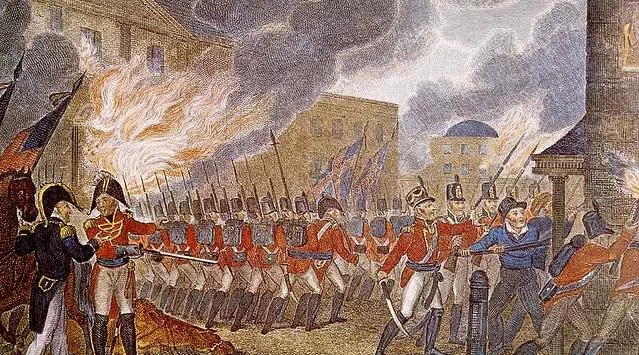
The Burning of Washington happened in August 1814, when British forces marched into the young American capital and set fire to the Capitol, the White House, and other government buildings during the War of 1812. It was a stunning humiliation for a nation that had declared war just two years earlier. As flames lit the night sky, First Lady Dolley Madison hurried to save a treasured portrait of George Washington before the enemy arrived. Then, in one of history's strangest turns, a violent storm swept in and helped drive the British out.
In August 1814, during the War of 1812, British troops defeated American militia at Bladensburg, Maryland, then entered Washington, D.C. and burned the Capitol and the President's House. President James Madison had fled. A powerful storm later struck the city and contributed to the British withdrawal.
- The Battle of Bladensburg took place on August 24, 1814, in Maryland, where British forces routed the American defenders and opened the road to Washington.
- British troops under Major General Robert Ross and Rear Admiral George Cockburn entered Washington, D.C. that evening and set fire to the Capitol and the President's House.
- Dolley Madison ordered the rescue of Gilbert Stuart's portrait of George Washington from the President's House before she left the city.
- A severe thunderstorm struck Washington after the burning began, and the British departed the city within roughly a day.
- Robert Ross was killed in September 1814 during the British campaign against Baltimore, and the war formally ended with the Treaty of Ghent that December.
The Day the Capital Burned
On the evening of August 24, 1814, British soldiers marched into Washington, D.C. and set the American capital ablaze. For more than 24 hours the city sat under foreign occupation while the White House, the Capitol, and a long list of public buildings went up in flames. It remains the only time in American history that a foreign power has occupied the U.S. capital.
Ask most people about attacks on American soil and you will hear about Pearl Harbor, maybe the Aleutian Islands campaign, and the September 11 attacks. The Burning of Washington rarely makes that list, which is a strange oversight for an event of this scale. The country's seat of government was taken, looted, and torched, and yet it slips past public memory.
There is a reason the capital was so exposed. The United States sits far from Asia and Europe, spread across a continent of its own, and that geography shielded the mainland from the destruction of two world wars and from most major assaults. In 1814, though, the shield did not hold.
The fires came during the War of 1812, a conflict with Great Britain that some historians call a second American revolution. The war had been simmering over unpaid Revolutionary-era accounts, British interference with American sea trade during the Napoleonic Wars, and British encouragement of Native nations living on the young country's frontier. A faction of Democratic and Republican congressmen known as the "war hawks" added their own ambitions to the mix, pushing to drive Britain out of North America and annex Canada. Thomas Jefferson, the principal author of the Declaration of Independence and a former president, made the case sound simple: taking Canada was, in his words, only "a matter of marching."
The first years of fighting played out along the Canadian border, especially around Niagara. Britain, pouring most of its resources into the war against Napoleon in Europe, stayed on the defensive. Then Napoleon's fortunes turned, and seasoned British troops crossed the Atlantic. In April 1813 they launched a campaign in the Chesapeake Bay, aiming to pull American attention north and to settle the score for American towns that had already been burned.
That campaign reached its peak on August 24, 1814, at Bladensburg, Maryland, about 14 kilometers northeast of Washington. Experienced British regulars tore through a mixed American force of regulars and militia. The clash went into the history books as "the greatest disgrace of the American army," and it opened the road straight to the capital.
Late that night, troops under General Robert Ross walked into Washington with little resistance. President James Madison's government had already fled, along with several military commanders. Ross, described by historians as an officer and a gentleman, had actually planned to take the city peacefully, against the retaliatory orders he had been given. That plan fell apart when shots rang out as his men advanced under a white flag, striking his horse and several of his soldiers. The Americans had barely defended their capital, losing not even a single company, and the scattered fire was one of their only counterattacks. Ross's answer was to order the looting to begin.
Why Britain and America Went to War
Some historians call the War of 1812 the "Second American Revolution," and the label fits better than you might expect. It was a fight over unfinished business from 1776, over sailors dragged off American ships, and over land in Canada that looked ripe for the taking. Britain, busy with Napoleon in Europe, had been treating the young United States less like a nation and more like a nuisance.
The grievances piled up slowly. There were old Revolutionary-era accounts that had never been settled. Then came the maritime insult: Britain's blockade of France during the Napoleonic Wars, a conflict usually dated to 1803 until 1815. To choke off French trade, the Royal Navy stopped American merchant vessels and impressed their sailors into British service. On the frontier, British agents were also stirring up Native American nations against American settlers, a threat that felt personal to people pushing westward.
Into this stew stepped a loud group of Democratic-Republican congressmen nicknamed the "War Hawks." They wanted Britain shoved out of North America entirely and Canada annexed to the United States. Thomas Jefferson, the principal author of the Declaration of Independence and a former president by then, made the case sound almost casual. Taking Canada, he said, would be "a mere matter of marching."
It was a confident prediction. The war that followed would prove it badly wrong, and the bill for that confidence would eventually come due in the streets of Washington.
The Chesapeake Campaign and the Battle of Bladensburg
The British Chesapeake campaign began in April 1813, when seasoned redcoats stepped off their ships along the bay. For a year and a half, this was a slow campaign of raids and landings that kept American eyes fixed nervously on the coast while the real prize of Canada slipped out of reach.
The timing was no accident. Britain had spent most of the war fighting Napoleon in Europe and could only defend along the Canadian border. Once Napoleon's defeats began to stack up, London suddenly had battle-hardened troops to spare. Those men landed in the Chesapeake for two reasons: to pull American attention away from Canada, and to settle the score for Canadian towns that American soldiers had put to the torch.
The campaign reached its climax on August 24, 1814, at Bladensburg, Maryland, roughly 14 km northeast of Washington, D.C. There, experienced British regulars slammed into an American force stitched together from regulars and militia. The result was a rout. History remembers Bladensburg as "the greatest disgrace of the American army," and after that shattered line, the road to the capital lay wide open.
By late that evening, the British under General Robert Ross walked into Washington almost unopposed. President James Madison's government had already fled. What followed was the Burning of Washington, the moment a young republic watched its own capital go up in flames.
Enter General Ross and the Burning of the Capitol
Late in the evening of August 24, 1814, British troops under General Robert Ross walked into Washington, D.C. with almost nothing in their way. President James Madison's government had already fled the city. The capital of the United States was, for the moment, an open door.
Ross was, by the description historians keep reaching for, an "officer and a gentleman." He had orders for retaliation, but he meant to take the city peacefully and accept its surrender. Then, as his men advanced under a white flag, shots rang out. His horse went down. Some of his soldiers were hit. That was the end of the gentleman's plan. Ross gave the order to loot.
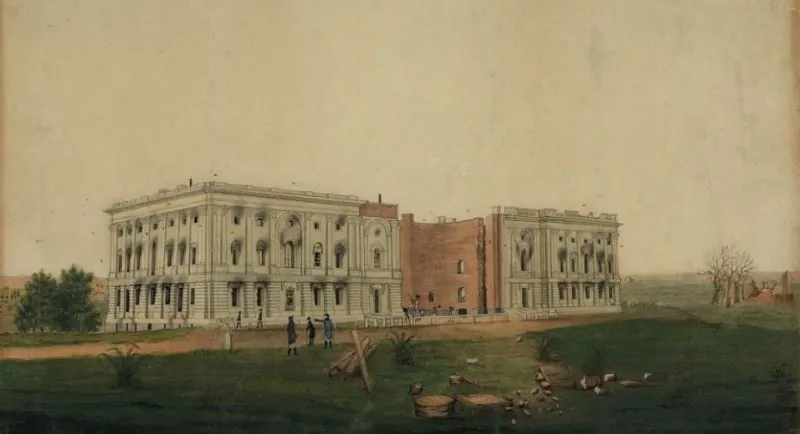
One of the first targets was the Capitol. In those years it looked nothing like the domed landmark we picture today, and travelers passing through considered it the only building in Washington worth seeing. Soldiers set the south wing, where the House met, ablaze first. Then they moved to the north wing and torched the Senate chamber too.
Before the flames, they looted. The Library of Congress, housed in the building, held roughly 3,000 volumes at the time, and those volumes went into British hands. Among the items carried off was a Treasury account book of U.S. revenues and expenditures. The precise year recorded inside that ledger is debated, but the book itself found its way home: it was returned to the Library of Congress in 1940, 126 years later.
A single volley under a white flag turned a planned surrender into the Burning of Washington.
What followed the Capitol is a story for the next stretch of the night. The soldiers turned northwest, up Pennsylvania Avenue, toward the president's house.
The President's Silver, the Portrait, and the Storm That Saved Washington
General Robert Ross's soldiers reached the White House before they put a torch to it, and they ate first. Officers sat down at President James Madison's table and feasted off his silver and his porcelain, laying out a spread in the executive mansion while the government that owned it was still scrambling out of town. Only after the meal did the burning begin.
Dolley Madison had already fled, and she did not leave empty-handed. With the help of enslaved people in the household, including Paul Jennings, she got the Gilbert Stuart portrait of George Washington out of the house before the British arrived. Contrary to a popular telling, she did not rescue the Declaration of Independence. The portrait is the real save, and Jennings was central to it.
The destruction didn't stop at the president's residence. The following day, a long list of public buildings went up in flames or were picked clean, the Treasury and the War Department among them. By then the Burning of Washington had touched nearly every seat of government the young country had.
Then the weather turned. A sudden storm rolled in and reportedly dumped about two hours of rain on the city, and the downpour put out the fires the British had set. Whether that soaking alone pushed Ross's men toward the door is a matter the accounts don't settle cleanly, but the storm has carried a nickname ever since: the tornado that saved Washington.
The Aftermath: Ross's Death, Lake Champlain, and the Treaty of Ghent
The burning of Washington did not end the war. In September 1814, General Robert Ross pushed on toward Baltimore and Maryland, where American riflemen shot him dead during the fighting near the city. Earlier that month, on September 11, 1814, a second British thrust aimed at New York was turned back at the Battle of Lake Champlain, an American naval victory that repelled the British advance.
With both offensives spent, the war ground to a stalemate. It closed on December 24, 1814, with the Treaty of Ghent, which restored the pre-war borders, the arrangement historians call status quo ante bellum. Nothing changed hands on the map.
Was the Washington campaign worth it? Most politicians and historians say no. They read the occupation as unnecessary, retaliation dressed up as strategy. The government of the day took heat for a different sin: it inflated the capture of a few buildings in what critics called a non-strategic swamp, as if Paris itself had fallen. The fires were real. The triumph, in the ledger of history, was not.
Trump, Trudeau, and the War of 1812
In March 2018, during a tense phone call with Canadian Prime Minister Justin Trudeau about steel and aluminum tariffs, President Donald Trump reached back two centuries and asked, "Didn't you guys burn down the White House?" The line caught everyone off guard, because the answer is no. The troops who set the White House ablaze in 1814 were British regulars, not Canadians, and Trump apparently believed that Canadians had occupied Washington, D.C.
Picture the call. Two leaders, one negotiating tariffs, and suddenly a question that sounds less like trade policy and more like a history pop quiz gone sideways. Trudeau, to his credit, did not take the bait, and the exchange was later reported by CNN and confirmed by officials familiar with the conversation.
The confusion is understandable, even if it is wrong. Canada in 1814 was not the country it is today. It was a collection of British colonies, and the soldiers who marched into Washington answered to the Crown in London. So when Trump asked whether "you guys" burned the White House, he was folding modern Canada into its colonial past.
"Didn't you guys burn down the White House?"
President Donald Trump, 2018 phone call with Justin Trudeau
What actually happened in 1814 was a British operation from start to finish. General Robert Ross led the troops, and the burning of Washington was ordered as retaliation for American attacks on Canadian settlements. No Canadian government existed to give the order, and no Canadian force carried it out.
The anecdote has stuck around because it captures something about how history gets remembered, or misremembered. A president with a famous name and a habit of speaking off the cuff, a prime minister on the other end of the line, and a two-century-old fire that somehow found its way into a trade dispute. It is the kind of moment that makes you want to check the facts yourself.
And the facts are clear. The British burned Washington in 1814. Canada did not. Trump's question, however memorable, rested on a misunderstanding of who was fighting whom, and why.
Frequently asked questions
What happened when the British burned Washington, D.C. in 1814?
British troops held Washington for more than 24 hours and burned the White House, the Capitol, and several other government buildings. Before torching the Capitol, they looted the Library of Congress, then home to a collection of 3,000 volumes. The next day they moved on the Treasury and War Department buildings.
How did Dolley Madison save the famous portrait of George Washington?
As the British approached, First Lady Dolley Madison worked with enslaved people, including Paul Jennings, to carry the Gilbert Stuart portrait of George Washington out of the White House before it was burned. Contrary to the popular version, she did not save the Declaration of Independence. The portrait she rescued now hangs in the White House collection.
Why did the British attack Washington, D.C. during the War of 1812?
The British struck the Chesapeake to pull American attention away from Canada and to avenge Canadian towns that American troops had burned. The Chesapeake campaign began in April 1813, and after Napoleon's defeats in Europe freed up seasoned British regiments, the raid on the capital became possible.
What was the Battle of Bladensburg and why is it called the greatest disgrace of the American army?
On August 24, 1814, at Bladensburg, Maryland, about 14 km northeast of Washington, experienced British regulars routed a mixed force of American regulars and militia. The Americans barely made a stand and lost the road to their own capital. Historians have remembered the engagement as the greatest disgrace of the American army.
Did a tornado really stop the burning of Washington?
A sudden, violent storm swept in while the looting was still underway, and heavy rain helped put out the fires. Accounts report that the downpour lasted about two hours and convinced the British it was time to leave the city. The exact role of the storm as the direct cause of the withdrawal is not firmly established.
Who was General Robert Ross and how did he die?
General Robert Ross commanded the British forces that marched into Washington on the evening of August 24, 1814. He was killed in September 1814 by American snipers while his troops were operating near Baltimore and in Maryland, during the fighting that followed the burning of the capital.
What were the main causes of the War of 1812?
The war grew out of unresolved grievances left over from the Revolution, British maritime restrictions imposed during the Napoleonic Wars, and British encouragement of Native Americans on the frontier. A group of congressmen known as the War Hawks also pushed hard for war, driven by the ambition of expelling Britain from North America and annexing Canada.
How did the Treaty of Ghent end the War of 1812?
Signed on December 24, 1814, the Treaty of Ghent ended the fighting and restored pre-war borders, the arrangement known as status quo ante bellum. Neither side gained territory on paper, though the burning of Washington had already left its mark on the American imagination. Editorial note: Details that remain unconfirmed, including some specifics of the storm's role and the exact sequence of events during the evacuation, are presented as reported accounts rather than settled fact.
Got a take on this? Add your voice to the conversation below →
No comments yet. Be the first.