Bombe Machine: How Turing Cracked Enigma's 150 Trillion Codes
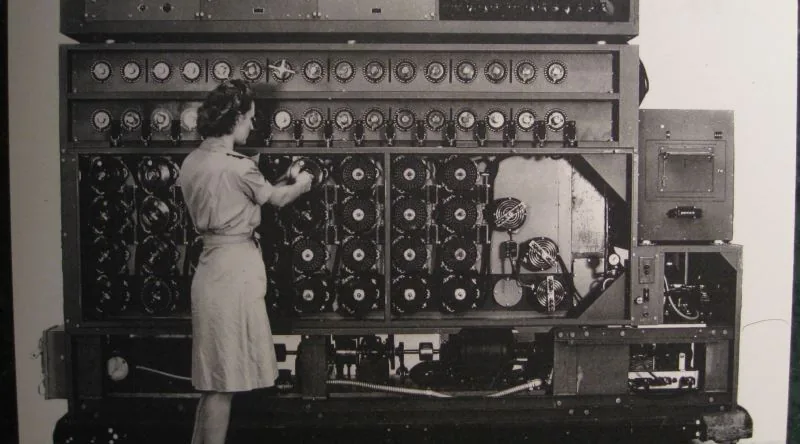
The Bombe machine, an electromechanical device designed by Alan Turing and his team at Bletchley Park, cracked Enigma's 150 trillion possible settings, giving Allied commanders the gift of foresight during World War II. That gift, delivered as decoded German military traffic, shifted the balance of power in the Atlantic and laid the strategic groundwork for the D-Day landings in 1944. It is a story of relentless logic, quiet desperation, and a machine that thought faster than any human ever could.
The Bombe machine, created by Alan Turing and his team at Bletchley Park, was a high-speed electromechanical device that tested Enigma's possible rotor settings. By eliminating impossible configurations, it reduced the search space dramatically, allowing codebreakers to read encrypted German messages throughout World War II, including those that supported the Normandy invasion.
- Alan Turing and his team designed the Bombe machine at Bletchley Park, England, with the first operational model delivered in early 1940.
- The Bombe machine worked by testing Enigma's rotor positions in batches, using a "menu" derived from a guessed plaintext phrase called a crib to eliminate wrong settings.
- By 1944, many Bombe machines were running around the clock at Bletchley Park, decrypting thousands of German messages each week.
- The intelligence from the Bombe machine, codenamed Ultra, informed Allied naval tactics in the Battle of the Atlantic and contributed to the success of the D-Day landings on June 6, 1944.
The Machine the Nazis Called Unbreakable
During World War II, the German military trusted a single machine to keep its most sensitive communications secret, and that machine was called Enigma. Its name means "unknown" or "puzzle" in Greek, and for years it lived up to that reputation. The encryption system could produce more than 150 trillion different combinations, which meant that cracking a single message by hand would have taken longer than a human lifetime. The Germans were so confident in this mathematical wall that they called it unbreakable.
They were wrong, and the thing that proved them wrong was the Bombe machine.
Enigma worked like a typewriter that scrambled letters through a series of rotors and plugs. Every time an operator pressed a key, the machine would rewire itself, creating a new cipher for each character. For the Germans, this was the ultimate security blanket. They changed the encryption settings every single day, so even if an enemy captured a machine, they still could not read the messages without knowing that day's configuration. The math was staggering. With so many possible settings, the odds of guessing correctly were essentially zero.
But the Allies did not try to guess. Instead, they built a machine of their own to do the guessing for them. The Bombe machine was developed at Bletchley Park, a secret codebreaking facility in England, by a team led by the mathematician Alan Turing. It was one of the most advanced mechanical computers of its era, a towering rack of spinning drums and clicking relays that hummed around the clock. Turing's design drew inspiration from an earlier device created by Polish mathematicians, but he refined it into something far more powerful. The Bombe worked by testing possible Enigma settings at lightning speed, looking for logical contradictions in the encrypted text and eliminating wrong answers until only the correct configuration remained.
When it worked, the results were dramatic. German submarines hunting Allied supply ships in the Atlantic suddenly found their positions known in advance, and convoys were rerouted to safety. Before the Normandy landings, Allied commanders knew where German defenses were strongest and where they were weakest. Lives were saved by the thousands, and the war was shortened because of it.
Here is the strange part. The people who operated the Bombe machine at Bletchley Park never told anyone what they had done. Not during the war, and not for decades after it ended. The secret of Enigma's fall was kept so tightly that the full story did not officially come out until 1974. Even the machine itself was dismantled and hidden away, its existence denied. For years, the men and women who had helped win the war simply went home and kept quiet about the greatest codebreaking achievement in history.
Alan Turing and the Birth of the Bombe Machine
The Bombe machine was born at Bletchley Park in England, the top-secret codebreaking estate where mathematician Alan Turing and his team took on the impossible. Polish mathematicians had already built a codebreaking device called the Bomba, invented by Marian Rejewski. Turing studied their work and transformed it into something far more powerful, a machine that would become one of the most advanced mechanical computers of its era.
The problem it solved was staggering. The German Enigma machine, whose name means "riddle" or "mystery," could produce over 150 trillion different encryption combinations. German military leaders believed their messages were unbreakable, and with good reason. No human could work through those possibilities by hand in a lifetime. But the Bombe machine could do something clever instead of brute-force guessing. It hunted for the daily encryption key by reversing the Enigma's transformations, looking for inconsistencies in the cipher that revealed the settings. Each day the Germans changed their key, and each day the Bombe had to find it again.
What made the Bombe so remarkable was its speed and mechanical elegance. It wasn't a digital computer in the modern sense, but a whirring array of rotating drums and electrical circuits that simulated multiple Enigma rotors at once. When it found a possible match, it stopped and let the operators check the result. The machine's success changed the war. German submarines hunting British supply ships in the Atlantic suddenly found their positions known in advance, and convoys were rerouted away from danger. Before the Normandy landings, Allied commanders knew German defenses and troop movements in detail because they were reading the enemy's own messages.
The secrecy around the Bombe held for decades. The people who worked at Bletchley Park never spoke about it, even after the war ended in 1945. The machine's existence and the breaking of Enigma remained classified until 1974, when the story finally came to light. Human ingenuity had quietly defeated a machine that seemed unbeatable.
How the Bombe Machine Cracked Enigma's Daily Codes
The Enigma machine reset its entire encryption system every single day, which meant the codebreakers at Bletchley Park in England had roughly twenty-four hours to crack that day's settings before everything changed again. The Bombe machine was their answer to this relentless deadline. It worked by running the Enigma's transformations in reverse, hunting for logical inconsistencies in intercepted messages until it found the one setting that made everything click into place.
Picture a room filled with spinning drums, clicking relays, and the constant hum of electrical circuits. That was the sound of the Bombe machine at work. Instead of trying every possible combination, which would have taken longer than the war itself, the Bombe took a smarter approach. The codebreakers fed it a "crib," a guessed piece of plaintext that they believed appeared in the encrypted message. German messages were full of predictable phrases like weather reports or "Heil Hitler," and those predictable words became the key.
The Bombe machine then simulated the Enigma's rotors in reverse, checking whether a particular rotor position could produce that known phrase. When it found a position that didn't contradict itself, the machine stopped. That stop meant the codebreakers had a probable setting for the day. From there, they could set up their own Enigma machines to match the German settings and read the messages as easily as the Germans did.
But here was the catch: every day brought a fresh scramble. The Germans changed the rotor order, the ring settings, and the plugboard connections daily. The Bombe machine operators worked in shifts around the clock, racing against that daily reset. Sometimes they cracked the code within hours. Sometimes it took most of the day. And on the days they failed, they simply had to wait for the next morning's messages and start the hunt all over again.
The whole operation depended on speed and precision. Each Bombe machine was a large and complex device, yet it could test thousands of possible settings in minutes. By 1944, Bletchley Park had many of these machines running day and night, each one a mechanical brain devoted to beating the clock before the next daily reset.
Turning the Tide: U-Boats and the Normandy Landings
The Bombe machine's real payoff came not in a quiet room at Bletchley Park, but in the cold Atlantic and on the beaches of France. By 1944, the Allies were reading German messages that were supposed to be unbreakable, and that advantage changed the course of the war.
The Germans encrypted everything strategic, from air raid warnings to submarine movements, using the Enigma machine. Every morning, the encryption settings changed, resetting the puzzle completely. But the Bombe machine, designed by Alan Turing and his team at Bletchley Park in England, could work through those daily changes faster than any human ever could.
The Atlantic was a graveyard in those years. German U-boats hunted in packs, sinking British merchant ships carrying food, fuel, and weapons. Britain was an island that needed constant supply, and the submarines were slowly strangling it. But once the Bombe machine cracked the daily codes, the Allies could pinpoint where those U-boats lurked. Convoys were rerouted around the danger zones, slipping past the hunters in the dark water. Vital supplies kept flowing, and the Battle of the Atlantic turned in the Allies' favor.
The same intelligence proved decisive on June 6, 1944, when Allied forces launched the Normandy landings, the largest amphibious operation in military history. German defenses along the French coast were formidable, with bunkers, gun emplacements, and minefields. Yet the Allies knew where those defenses were, how many troops guarded them, and where the German reserves were positioned. The decrypted messages gave them a map of the enemy's intentions before a single landing craft hit the sand.
That foreknowledge made the difference between a gamble and a calculated strike. The Bombe machine did not fire a single shot, but it shifted the balance of power across every theater of the war. The men and women who operated it at Bletchley Park understood their work mattered, yet they never spoke of it. Even after the war ended, the existence of the Bombe machine and the breaking of Enigma remained a closely guarded secret, kept hidden for decades until the full story finally came to light.
The Secret That Outlasted the War
The men and women who worked at Bletchley Park in Buckinghamshire, England, carried a burden that had no expiration date. During World War II, they broke the German Enigma codes and operated the Bombe machine, yet they told no one. Not their spouses, not their parents, not their closest friends. The silence held long after the guns fell silent in 1945.
The British government classified the entire operation under the Ultra secret. For nearly three decades, the public knew nothing of the codebreaking triumph. The Bombe machine, which had helped steer the course of the war, sat in obscurity, its existence denied or simply never mentioned. Veterans returned to civilian life and resumed ordinary jobs, keeping their wartime roles locked away as if they had never happened.
That wall of secrecy finally cracked in 1974. F.W. Winterbotham, a Royal Air Force officer who had been involved in intelligence distribution during the war, published a book called The Ultra Secret. For the first time, the world learned that the Allies had been reading German encrypted messages throughout the conflict. The revelation landed like a thunderclap, reshaping how historians understood the war and finally giving credit to the quiet geniuses of Bletchley Park.
Think about what that secrecy cost the codebreakers. They had helped shorten the war, saved countless lives, and altered the fate of Europe. Yet they could not claim any of it. A wife might have wondered why her husband disappeared at odd hours or why he seemed haunted by things he would not name. He could only say he worked for the Foreign Office or some other vague cover. The truth remained buried until Winterbotham's book pried it loose.
When the secret finally emerged, the world began to understand the scale of what had happened. The Bombe machine, designed by Alan Turing and his team, had been one of the war's most closely guarded assets. Its contribution to the Allied victory had been invisible for decades, hidden behind official secrecy and personal discipline. The codebreakers had not sought glory, and for thirty years, they received none.
Their legacy, though, could not stay hidden forever. Once the Ultra secret became public, historians reexamined the war with fresh eyes. The Battle of the Atlantic, the Normandy landings, the campaigns across North Africa and Europe, all of it looked different when viewed through the lens of what the Allies had known in advance.
The quiet heroism of those Bletchley Park workers stands as a reminder that some victories are won in silence. They did the work, kept the secret, and waited. The Bombe machine's legacy, long hidden, now stands as one of the most remarkable achievements of the twentieth century, a story that proves the sharpest weapon in any war is often the one nobody talks about.
Frequently asked questions
What was the Bombe machine?
The Bombe machine was an electromechanical device designed to break the codes produced by the German Enigma cipher machine. It worked by testing possible daily settings, looking for logical inconsistencies in intercepted messages. Each Bombe was a large and complex device that contained rotating drums mimicking Enigma's internal wiring, allowing codebreakers to narrow down the correct settings far faster than any human could.
Who invented the Bombe machine?
Alan Turing designed the Bombe at Bletchley Park, with engineering carried out by Harold Keen at the British Tabulating Machine Company. Turing's design was based on an earlier Polish device called the Bomba, created by mathematician Marian Rejewski. Polish cryptanalysts shared their breakthroughs with British intelligence before the war broke out.
How did the Bombe machine crack Enigma codes?
The Enigma machine changed its encryption settings every day, creating over 150 trillion possible combinations. The Bombe worked by reversing Enigma's transformations, using a "crib" or guessed plaintext phrase to identify inconsistencies in the encrypted message. When the machine found a setting that produced no contradictions, it flagged that as a likely key, which codebreakers then tested to decode the day's traffic.
Did the Bombe machine help win World War II?
Yes, the intelligence produced by the Bombe machine proved vital to the Allied war effort. In the Battle of the Atlantic, decrypts revealed the locations of German U-boats, allowing convoys to be rerouted around danger zones and keeping supply lines to Britain open. Before the Normandy landings in June 1944, the Bombe helped the Allies learn German defensive positions and troop movements, giving them a significant tactical advantage on D-Day.
Was the Bombe machine kept secret after the war?
The existence of the Bombe machine and the successful breaking of Enigma remained classified for nearly three decades. The secret was not officially revealed until 1974, when former intelligence officer F.W. Winterbotham published his book The Ultra Secret . The codebreakers at Bletchley Park had signed strict secrecy agreements and kept their work hidden even from family members until the information was finally declassified. Editorial note: Some operational details of the Bombe machine's daily use remain unconfirmed in public records, and any such facts are presented here as hedged rather than definitive.
Got a take on this? Add your voice to the conversation below →
No comments yet. Be the first.