Ancient Egypt Daily Life: Mudbrick Homes & Linen
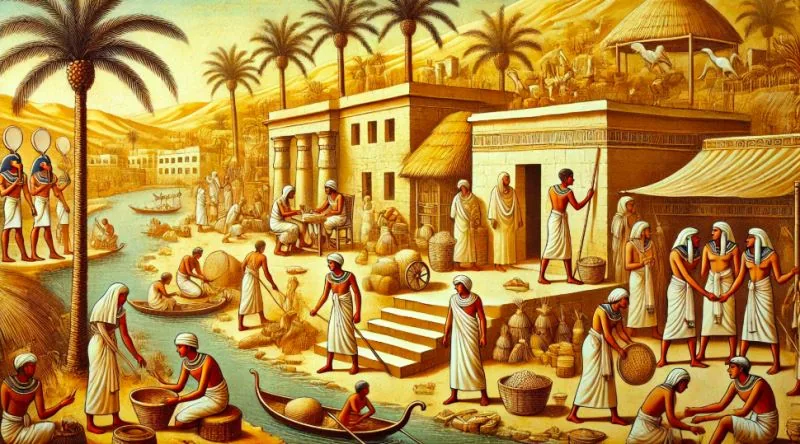
Ancient Egypt daily life centered on humble mudbrick homes, breathable linen clothing, and a grain-based diet, a reality best preserved in the worker village of Deir el-Medina. These everyday details pull back the curtain on a civilization often reduced to pyramids and pharaohs, revealing people who loved, laughed, and labored just as we do. Peering into their simple houses and wardrobes makes them feel startlingly close, even after three thousand years.
Ancient Egyptians built homes from sun-dried mudbrick, wore light linen garments, and ate bread and beer made from grain. The village of Deir el-Medina, occupied by tomb workers, provides the clearest picture of this daily existence, showing skilled artisans, doctors, and families living in tight-knit community.
- Mudbrick houses in Deir el-Medina were narrow, multi-room structures with wooden front doors opening onto the main street, clustered near the royal tombs.
- Linen was the fabric of choice for ancient Egyptian clothing, prized for its coolness in the hot climate, with workers wearing simple kilts and women in plain, similar-style dresses.
- The staple diet of ancient Egyptians consisted mainly of grain, whether wheat or barley, turned into bread and beer.
- Ancient Egyptian doctors were considered the best of their time, practicing a blend of practical knowledge and ritual healing.
- Deir el-Medina was home to the artisans who built royal tombs, and their preserved records offer unmatched detail on how ancient Egyptians lived everyday.
Life Was Hard, Even With the Highest Birth Rate
Ancient Egypt is sometimes said to have had one of the highest birth rates in the ancient world, though comparative demographic data is too sparse to be certain. Yet daily existence there was far from comfortable. Disease and accidents struck without warning, and no social safety net existed to catch those who fell on hard times. The land along the Nile was fertile and generous, but it demanded constant labor and offered no guarantees.
Picture a civilization that could raise pyramids and carve temples from stone, but where ordinary families lived in homes made of mudbrick. The Egyptians saved their precious stone for the gods and the dead, building their towns and cities from humble sun-dried clay. It was cheap and quick to construct, though it meant that nearly every domestic building eventually crumbled back into the earth.
This is the world we are about to step into, a place where the grandeur of monuments hides a gritty, day-to-day struggle for survival. Exploring how ordinary Egyptians lived means looking past the gold and the glory to see how real people cooked, dressed, worked, and healed. The picture that emerges is more human, and more surprising, than the polished tomb paintings suggest.
Mudbrick Homes: Why the Pyramids Survived but Houses Didn't
Ancient Egyptians built their towns and cities from mudbrick, reserving precious stone almost exclusively for temples and tombs. This practical choice shaped everything about how people lived along the Nile, and it explains a curious mystery that puzzles visitors even today.
Walk through modern Cairo and you will see the pyramids still towering after thousands of years. Yet archaeologists have found almost no intact homes from the same era. The explanation is simple: mudbrick was cheap and quick to construct, which made it perfect for everyday living, but it was never meant to last forever. While the pharaohs carved their burial chambers from solid rock, ordinary families raised their walls from sun-dried mud mixed with straw. When those homes eventually crumbled, the materials simply returned to the earth they came from.
One remarkable exception survives. Deir el-Medina, a village built for the workers who constructed royal tombs, has come down to us relatively intact. The terraced houses there were long, narrow, and dark, with wooden front doors opening directly onto the main street. Each home followed a standard layout: two sitting or common rooms, a storage space or bedroom, and a kitchen equipped with a mudbrick oven. The kitchen roof was made of matting rather than solid material, letting smoke and cooking smells drift upward and out. Stairs led to the rest of the roof, which families used as extra living space in the warm climate.
This glimpse into everyday existence along the Nile reveals how thoughtfully these homes were designed for their environment, even if they could not rival the permanence of stone monuments. The builders of Deir el-Medina knew exactly what they needed from their houses: shade from the sun, ventilation for cooking, and room to live and sleep. They got all of that from mudbrick, and their village survived the centuries.
Deir el-Medina: A Time Capsule of Worker Homes
Deir el-Medina, the village built for the craftsmen who carved the royal tombs, survived the centuries almost completely intact. That makes it the single best window we have into how ordinary Egyptians lived. While nearly every other mudbrick town from the era crumbled back into the earth, this one held on.
The houses themselves tell a story of practical living. They were long, narrow, and dark, with a wooden front door that opened straight onto the main street. No porches, no courtyards in front, just a door that swung out into the dust and noise of the village thoroughfare.
Inside, the layout was remarkably consistent. Every home had two sitting or common rooms where the family gathered, plus a storage room that doubled as a bedroom. The kitchen came with a mudbrick oven, and here is where things get clever. The roof over the cooking area was made of woven matting instead of solid mudbrick. That let the smoke and the smells of the day's meal drift up and out instead of choking the room. A set of stairs led to the rest of the roof, which families used as extra living space. In the hot Egyptian climate, sleeping under the stars on that rooftop was probably a relief.
These were not grand homes. They were tight, functional spaces built for people who spent their days underground, chiseling tombs for pharaohs. And yet the village itself has given archaeologists more detail about ordinary existence than almost any other site in Egypt. It is a rare thing, this kind of preservation. Most mudbrick settlements vanished long ago, which is why Deir el-Medina matters so much to anyone curious about daily life in ancient Egypt.
Grain, Water, and Linen: The Simple Staples of Everyday Life
Daily life in ancient Egypt revolved around a handful of essentials that seem almost startlingly plain to us today: grain for food, water from the Nile, and linen on everyone's back. The land along the river was fertile, and wheat and barley formed the backbone of nearly every meal. Getting a drink was rarely a struggle.
Water arrived through three routes, depending on where you lived. Some households drew it straight from dug wells. Others walked to the Nile River itself, which snaked through the country like a liquid highway. And in the fields, the Egyptians themselves built irrigation canals that carried river water to crops that would otherwise have baked under the sun. It was a system that worked well for a very fertile country.
What people wore tells a quieter story about equality and practicality. Archaeological digs have turned up evidence that women across different households wore simple linen dresses that looked remarkably alike. Cotton and silk simply did not exist in ancient Egypt, so linen, spun from flax, was the fabric of choice for everyone. Men out in the fields kept things even simpler, working in short kilts that left their legs free for the heat and the bending, hauling, and planting that field labor demanded.
The most vivid picture of this everyday world comes from Deir el-Medina, a village built for the workers who carved the royal tombs. Its houses were long, narrow, and dark, with a wooden front door opening straight onto the main street. Inside, each home had two sitting rooms, a storage or bedroom space, and a kitchen equipped with a mudbrick oven. The roof over that kitchen was made of matting, letting smoke and cooking smells drift out instead of choking the family below. Stairs led up to the rest of the roof, which doubled as extra living space in the warm evenings.
Doctors, Mummies, and a Misunderstood Body
Egyptian doctors were considered the finest of their time, a reputation that spread across the ancient world. Their skill came from an unusual classroom: the embalming table. The practice of mummification gave them a front-row seat to the human body's inner workings, something few other ancient cultures could claim.
Centuries before modern anatomy, these physicians could tell you exactly where the liver sat or how the intestines coiled. They knew the layout of organs with impressive precision. But knowing where things are is not the same as understanding what they do. And here, their brilliant minds hit a wall.
The Egyptians believed the heart was the command center of everything. Around it, they imagined a network of channels, what they called "metu," running through the body like irrigation canals across the Nile floodplain. Blood vessels, tear ducts, and nerves were all lumped into this single system. In their view, these channels carried not just blood but also air, tears, and other fluids, all flowing from the heart's authority.
It was a beautiful theory, elegant in its symmetry, and utterly wrong. They had no concept of circulation. The heart, they insisted, was the seat of the mind and emotions.
Still, their practical knowledge saved lives. Mummification gave them a working awareness of how organs are arranged inside the body. The error lay in the invisible, in the systems they could not see working. Their certainty about the heart's role is a reminder that even the best minds of an era can be sure about things that are not so.
Frequently asked questions
What was daily life like in ancient Egypt?
Daily life in ancient Egypt centered on the family home, agricultural work, and the rhythms of the Nile. People lived in mudbrick houses, ate bread and beer made from grain, and dressed in simple linen garments. Men worked the fields or learned trades while women managed households, and the whole family contributed to daily survival.
Why did ancient Egyptians build homes from mudbrick?
Ancient Egyptians built their towns and cities from mudbrick because it was cheap and quick to work with. Stone was reserved for temples and tombs, which were meant to last forever. The problem with mudbrick was that it did not last; nearly all of these homes have crumbled over time, which is why so little domestic architecture survives today.
What did ancient Egyptians eat as their staple diet?
Grain, whether wheat or barley, formed the backbone of the ancient Egyptian diet. These grains were turned into bread and beer, which were consumed by nearly everyone across society. Egypt was a very fertile country, and the abundance of grain made it possible to feed large populations working on state projects.
What kind of clothing did ancient Egyptians wear?
Ancient Egyptian women wore simple, similar-style dresses made of linen, a fabric that suited the hot climate. Cotton and silk were completely unknown in Egypt during this period. Men, especially those working in the fields, wore kilts that allowed freedom of movement while they labored under the sun.
Why were ancient Egyptian doctors considered the best?
Ancient Egyptian doctors were regarded as the best of their time by neighboring cultures and their own records. Their practical knowledge of anatomy, gained through mummification, and their skill in treating common ailments impressed other ancient societies. This reputation was well known across the ancient world.
What did ancient Egyptians misunderstand about the human body?
Although mummification gave ancient Egyptians practical knowledge of where organs sit in the body, their understanding of how bodily systems worked was incorrect. They believed the heart was the center of a network of channels that carried blood, air, tears, and other fluids. This system conflated what we now know as blood vessels, tear ducts, and nerves into a single imagined network.
What is Deir el-Medina and why is it important?
Deir el-Medina is a village that housed the workers who built royal tombs, and it has survived relatively intact. Each house there had two sitting or common rooms, a storage or bedroom space, and a kitchen with a mudbrick oven. The kitchen roof was made of matting to let smoke and cooking smells escape, and stairs led to a roof that served as extra living space.
How did ancient Egyptians get their water?
Water in ancient Egypt came from three main sources: wells dug into the ground, the Nile River itself, and irrigation canals that the Egyptians constructed. These canals were essential for bringing water to fields away from the river and for supporting agriculture across the floodplain. The system was well suited to the fertile land along the Nile. Editorial note: Any facts which remain unconfirmed are presented as such, hedged appropriately to reflect the limits of archaeological evidence.
Got a take on this? Add your voice to the conversation below →
No comments yet. Be the first.